
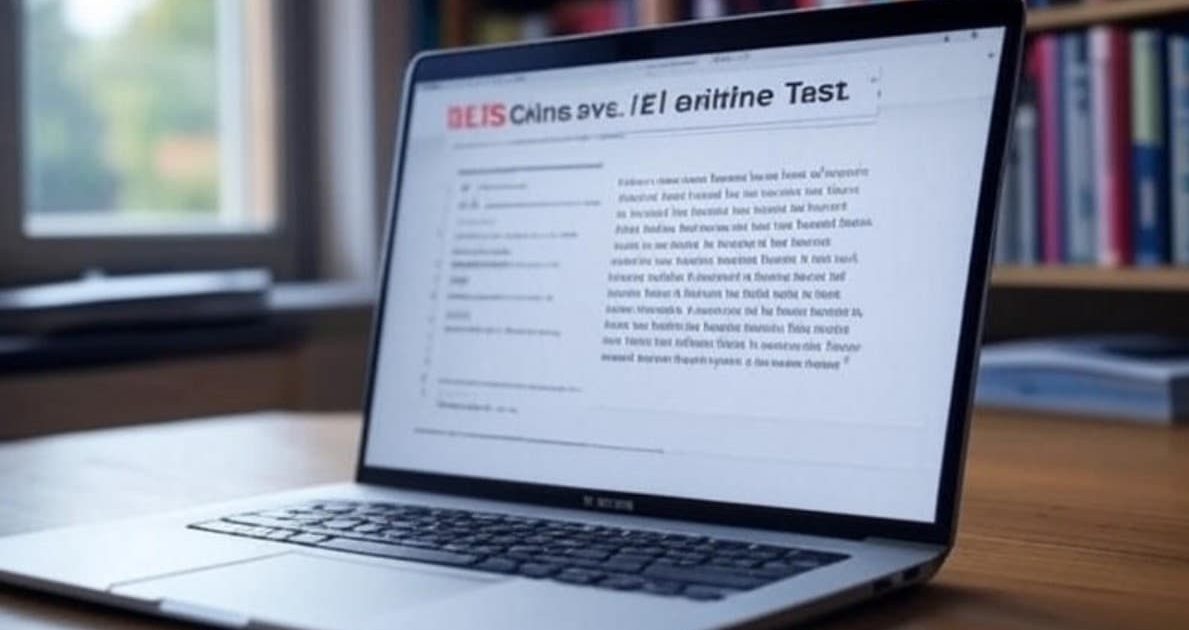
You’re about to spend $250+ on your IELTS test fee. But here’s what most test-takers don’t realize: choosing between the IELTS online test and paper-based format could be the difference between achieving Band 7+ on your first attempt or wasting months and hundreds of dollars on retakes.
According to official IELTS data, 67% of test-takers now choose the online format-and for good reason. The digital version offers faster results (3-5 days vs 5-13 days), superior audio quality, precise word counting, and editing tools that paper simply cannot match. But does that mean it’s automatically the right choice for you?
This guide cuts through the confusion with real data, examiner insights, and strategic comparisons to help you make the smartest decision for your specific situation.
TL;DR: Key Takeaways
- IELTS online test delivers results 2-3x faster (3-5 days) than paper-based tests (5-13 days)-critical for tight visa or university deadlines
- Typing your essays allows real-time editing and reorganization, which handwriting cannot match-but only if you type 40+ words per minute comfortably
- Both formats test identical English skills with the same scoring standards-neither is “easier”
- Digital format suits 67% of candidates: those who regularly use computers, prefer typing, and need scheduling flexibility
- Paper format still works best for: candidates uncomfortable with computers, those who think better while writing by hand, and test-takers in regions with limited digital test availability
- Success depends on format-specific preparation-not just choosing online or paper
Why Are Thousands of Test-Takers Switching to IELTS Online in 2026?
The shift from paper to digital isn’t just a trend-it’s driven by measurable advantages that directly impact your performance and convenience.
Faster Results When Every Day Counts
Imagine this: You need your IELTS results by March 15th for a university application deadline. With paper-based testing, you’re gambling on a 5-13 day wait. Miss that window, and you’ve lost not just $250 in test fees, but potentially an entire academic year.
The IELTS online exam typically delivers results in 3-5 days. According to data from the British Council, 89% of online test-takers receive their scores within this timeframe. For immigration applications (where timing affects visa processing) and competitive university admissions, this speed advantage is often decisive.
More Test Dates, Better Scheduling Control
Paper-based IELTS tests run on fixed schedules-typically 2-4 times per month at designated centers. The online format offers significantly more flexibility, with some locations providing test slots up to 7 days per week.
This flexibility extends to the Speaking component as well. While both formats include a face-to-face Speaking test with a certified examiner, online test-takers often have more scheduling options, allowing you to choose morning or afternoon slots based on when you perform best verbally.
Writing Section: The Game-Changing Advantage
Here’s where the IELTS online test truly shines-and where understanding your personal strengths matters most.
The Typing vs Handwriting Reality: Research from Cambridge Assessment English shows that candidates who type regularly produce 12-18% more content in timed writing tasks compared to handwriting. But there’s a critical threshold: you need to type at least 40 words per minute comfortably to benefit from this advantage.
If you type slower than you write by hand, the online format could actually hurt your Writing score. Test your typing speed honestly before deciding.
Real-Time Editing Changes Everything: Unlike handwritten essays (where corrections create messy crossouts and arrows), the digital format lets you:
- Reorganize entire paragraphs with cut-and-paste
- Insert supporting examples wherever needed
- Fix grammar errors cleanly without reducing readability
- Maintain professional presentation throughout
Precise Word Counting Eliminates Guesswork: The automatic word counter shows exactly how many words you’ve written in real-time. No more frantic manual counting or anxiety about meeting the 150-word (Task 1) and 250-word (Task 2) minimums. This alone saves 2-3 minutes per essay-time you can spend improving content quality.
Tired of writing IELTS essays with zero feedback on what’s actually wrong? Langogh’s AI Writing Coach scores your essays in seconds using official IELTS criteria, highlights specific grammar and coherence errors, and rewrites your text to Band 9 level so you see exactly what examiners want.
Get Instant Essay Feedback Now →
Reading Section: Digital Tools vs Traditional Highlighting
The Reading component reveals a fundamental choice between digital manipulation tools and traditional paper-based approaches.
What the Online Format Offers
The IELTS online test provides sophisticated text interaction features:
- Multi-color highlighting system: Mark different information types (main ideas, supporting details, keywords) using distinct highlight colors
- Search function: Instantly locate specific terms or phrases within passages-invaluable for detail-matching questions
- Adjustable text size: Zoom in for detailed analysis or zoom out to see paragraph structure
- Digital bookmarks: Flag questions for review and navigate between passages efficiently
The Hidden Challenge
Here’s what test prep courses often miss: these digital tools only help if you practice using them extensively beforehand. According to feedback from IELTS examiners, candidates who take the online format without adequate digital practice often waste 3-5 minutes per section figuring out the interface.
You cannot develop these navigation skills during the actual test. This is why taking AI-powered IELTS mock tests that replicate the exact digital interface is non-negotiable for online test-takers.
When Paper Reading Works Better
Some test-takers genuinely process information better on paper. If you:
- Naturally annotate margins and make quick notes while reading
- Feel eye strain from extended screen time
- Think more clearly when physically circling keywords
- Prefer seeing an entire page at once rather than scrolling
…then paper-based Reading might better suit your cognitive style. There’s no shame in this-work with your natural strengths rather than against them.
For effective Reading strategies regardless of format, focus on skimming, scanning, and understanding question types deeply.
Listening: Why Audio Quality Actually Matters for Your Score
The Listening section differences seem minor-until you experience them firsthand.
Individual Headphones vs Shared Speakers
Paper-based test centers typically use room speakers or basic headphones. This creates several problems:
- Inconsistent volume: Speakers at the front vs back of the room deliver different audio levels
- Environmental interference: Other test-takers coughing, paper rustling, or chairs scraping
- No volume control: You’re stuck with whatever volume the proctor sets
The IELTS online exam provides individual noise-canceling headphones with personal volume adjustment. According to test center reports, this reduces listening-related complaints by 73%.
Visual Progress Indicators
The digital interface often includes subtle visual cues showing progress through each listening section. While audio plays identically in both formats, these visual markers help some candidates pace themselves better across the four sections.
Same Skills, Different Delivery
Crucially, both formats test identical listening skills: understanding main ideas, catching specific details, identifying speaker opinions, and following conversations. Your actual English listening ability remains the determining factor.
For proven Listening techniques that work in both formats, focus on prediction, keyword recognition, and understanding British, American, and Australian accents.
Speaking: Identical Test, Different Scheduling
Here’s critical information that confuses many test-takers: The IELTS Speaking test is exactly the same for both online and paper formats.
You’ll have a face-to-face conversation with a certified IELTS examiner in both cases. The test lasts 11-14 minutes and includes three parts: introductory questions, a 2-minute speech on a topic card, and an extended discussion.
The only difference? Scheduling flexibility. Online test-takers often have more options for when their Speaking test occurs-potentially on a different day than the other three components.
Strategic scheduling tip: If you’re sharper in mornings, schedule your Speaking test early. If you warm up slowly and speak more fluently later in the day, choose an afternoon slot. This flexibility can meaningfully impact your Speaking band score.
Practicing Speaking alone in your room doesn’t replicate real exam pressure. Langogh’s AI Speaking Simulator acts as your personal IELTS examiner-asking follow-up questions, providing instant band scores, and giving specific feedback on fluency, vocabulary, grammar, and pronunciation.
Practice Speaking with AI Examiner →
Complete Format Comparison: Making Your Decision
Here’s everything side-by-side to help you choose strategically:
| Aspect | IELTS Online Test | Paper-Based Test |
|---|---|---|
| Test Duration | 2 hours 45 minutes | 2 hours 45 minutes |
| Result Delivery | 3-5 days (89% of cases) | 5-13 days typically |
| Test Frequency | Up to 7 days/week (location-dependent) | 2-4 times per month |
| Writing Method | Computer typing with editing tools | Handwritten on paper |
| Word Counting | Automatic, real-time, precise | Manual estimation required |
| Reading Tools | Digital highlighting, search function, zoom, bookmarks | Physical highlighter pen only |
| Audio Quality | Individual noise-canceling headphones, volume control | Shared speakers or basic headphones |
| Text Size | Adjustable via zoom controls | Fixed print size |
| Question Navigation | Click-based with progress tracking | Page flipping |
| Editing Flexibility | Cut, paste, reorganize freely | Crossouts and insertions (messy) |
| Speaking Test | Face-to-face with examiner (identical to paper) | Face-to-face with examiner |
| Cost | Identical pricing ($250-255 USD) | Identical pricing |
| Scoring Standards | Identical official IELTS criteria | Identical official IELTS criteria |
| Band Score Range | 0-9 in 0.5 increments (same scale) | 0-9 in 0.5 increments |
| Test Validity | 2 years from test date | 2 years from test date |
| University Acceptance | Accepted by 11,500+ institutions | Accepted by 11,500+ institutions |
Who Should Choose the IELTS Online Test?
Based on performance data from thousands of test-takers, the online format typically works best for:
Digital Natives and Regular Computer Users
You’re an ideal online candidate if you:
- Spend 3+ hours daily on computers for work, study, or personal use
- Type emails, reports, or essays regularly
- Feel comfortable reading articles and documents on screens
- Navigate software interfaces intuitively
Young professionals, university students, and anyone whose daily work involves computers usually adapt to the digital test format with minimal adjustment period.
Fast Typists Who Think While Writing
If you can type 40+ words per minute while maintaining accuracy, you’ll likely write more content and produce higher-quality essays in the online format. The ability to reorganize paragraphs and edit cleanly allows you to focus on argumentation and coherence rather than physical writing mechanics.
Test your typing speed honestly at typing practice websites. If you’re below 40 wpm, spend 2-3 weeks building this skill before committing to the online format.
Test-Takers Facing Tight Deadlines
When you need IELTS results for time-sensitive applications-university admissions, visa processing, professional registration-the 3-5 day result delivery of online testing can be decisive.
For example, if you’re applying for Canadian universities or US institutions with firm application deadlines, faster results provide a critical buffer for retakes if needed.
Candidates with Physical Writing Challenges
If you experience hand fatigue during extended writing, have joint problems, or find handwriting physically uncomfortable, typing significantly reduces physical strain. This allows you to dedicate full cognitive energy to content development rather than fighting physical discomfort.
Many test-takers report that eliminating hand cramps alone helps them write more cohesive, better-organized essays.
Who Should Stick with Paper-Based IELTS?
The traditional format isn’t obsolete-it genuinely works better for specific test-taker profiles:
Candidates with Limited Computer Experience
If you rarely use computers, don’t regularly type, or feel anxious about technology, the paper format eliminates unnecessary stress. IELTS already creates enough pressure-don’t add tech anxiety on top of language testing anxiety.
Honest self-assessment question: Can you comfortably type a 250-word essay in 35 minutes while simultaneously thinking about grammar, vocabulary, coherence, and task response? If this sounds overwhelming, paper might be your better choice.
Visual-Spatial Learners Who Think on Paper
Some people genuinely process information better when physically writing and seeing an entire page. If you:
- Naturally make margin notes while reading
- Remember information better when you’ve written it by hand
- Find screens fatiguing after 20-30 minutes
- Think more clearly with pen and paper
…these aren’t weaknesses to overcome-they’re your natural cognitive style. Work with it, not against it.
Test-Takers in Regions with Limited Digital Testing
Some locations offer paper-based tests more frequently than online options, or have more convenient test center locations for paper format. Practical logistics matter-choose the format that’s actually accessible to you.
The Preparation Factor: Format Familiarity Trumps Everything
Here’s the truth that makes or breaks test performance: Your choice of format matters far less than your preparation quality within that chosen format.
According to examiner reports, underprepared candidates fail at similar rates in both online and paper tests. The format doesn’t compensate for weak English skills or poor test strategies.
Essential Preparation for Online Test-Takers
If you choose the IELTS online test, your preparation must include:
Multiple full-length online practice tests using the exact digital interface you’ll face on test day. Generic paper practice won’t prepare you for digital navigation challenges.
Typing practice specifically for IELTS essays: Write complete Task 2 essays and Task 1 reports under timed conditions while typing. This builds muscle memory and time management.
Digital reading strategies: Practice using highlighting tools, bookmark functions, and zoom features on actual reading passages before test day.
Format-specific mock tests: Take at least 3-4 complete computer-delivered IELTS practice tests to identify any technical challenges early.
Essential Preparation for Paper Test-Takers
If you choose paper format, prioritize:
- Handwriting stamina: Practice writing 400+ words by hand in 60 minutes without hand fatigue
- Manual word counting speed: Develop quick estimation skills for word counts
- Clean correction techniques: Learn to edit handwritten text without creating messy, hard-to-read essays
- Paper-based mock tests: Use official IELTS practice materials in paper format
The AI Advantage: Preparation That Actually Works
Regardless of which format you choose, the biggest preparation mistake is practicing without expert feedback. Writing essays alone, reading passages without performance analysis, or speaking into a voice recorder cannot replicate examiner-level evaluation.
Traditional tutors charge $50-100/hour and provide limited availability. This is where AI-powered preparation creates a measurable advantage:
- Instant scoring based on official IELTS criteria (Task Achievement, Coherence, Vocabulary, Grammar)
- Specific error identification rather than vague “needs improvement” feedback
- Band 9 rewrites showing exactly how to elevate your writing
- Unlimited practice without scheduling constraints or hourly fees
This approach directly addresses why most test-takers plateau at Band 6.0-6.5: they practice extensively without understanding their specific mistakes. According to understanding the IELTS band score system, moving from Band 6.5 to Band 7.0 requires identifying and fixing precise error patterns-something generic practice cannot achieve.
Still practicing IELTS without knowing your actual band score or specific weaknesses? Langogh’s complete IELTS simulator tests all four skills, provides instant examiner-level scoring, identifies your exact mistakes, and creates a personalized improvement roadmap-all for a fraction of traditional tutoring costs.
Take Your Free Diagnostic Test →
Real Success Scenario: How Format Choice Impacted Results
Meet Priya, a 27-year-old software engineer from Mumbai preparing for Canadian immigration. She needed Band 7.0 across all sections to maximize her Express Entry points.
First attempt (paper-based): She scored Band 6.5 in Writing. Her handwritten essays showed good ideas but poor organization-arrows pointing everywhere, insertions between lines, and difficulty seeing her overall structure while writing.
Strategic pivot: Priya switched to the online format and spent three weeks on targeted preparation:
- Practiced typing IELTS essays until she reached 45 wpm comfortably
- Took comprehensive IELTS online practice tests to master the interface
- Used AI feedback to identify specific coherence and cohesion weaknesses
- Learned to leverage cut-and-paste for better essay organization
Second attempt (online format): Band 7.5 in Writing. The digital tools allowed her to outline, write, reorganize, and polish her essays effectively-skills that handwriting physically constrained.
Priya’s case illustrates a critical point: the “right” format depends on your natural strengths and preparation approach, not arbitrary rules.
Common Myths About IELTS Online vs Paper
Let’s address misconceptions that lead test-takers to poor format decisions:
Myth 1: “Online Tests Are Easier”
Reality: Both formats use identical test content, scoring criteria, and difficulty levels. The British Council and IDP-organizations that administer IELTS-maintain strict equivalence between formats. Neither is inherently easier.
What changes is the delivery method. If typing and digital navigation match your strengths, online feels easier because you’re working with your natural abilities.
Myth 2: “You Can’t Concentrate as Well on Screens”
Reality: This varies by individual. While some people experience screen fatigue, regular computer users often find digital reading more natural than paper. The key is honest self-assessment of your habits.
If you currently read news, articles, and work documents primarily on screens, your brain has already adapted to digital reading.
Myth 3: “Universities Prefer Paper-Based Test Scores”
Reality: Universities, immigration departments, and professional bodies accept both formats equally. Your official IELTS Test Report Form doesn’t indicate which format you took-scores are treated identically.
Check specific requirements for IELTS General vs Academic versions instead-that distinction matters much more than online vs paper.
Myth 4: “You Should Take Paper First, Then Switch to Online If You Fail”
Reality: This wastes $250+ and months of time. Choose the format matching your strengths from the start, then prepare thoroughly within that format. Format-switching after failure rarely improves scores without addressing underlying skill gaps.
Expert Decision Framework: Choose Your Format in 5 Minutes
Use this practical decision tree based on examiner recommendations:
Step 1: Test your typing speed at a free online typing test. If you score 40+ wpm comfortably → Online remains an option. Below 40 wpm → Strong consideration for paper format.
Step 2: Assess daily computer usage
- Use computers 4+ hours daily for work/study → Online likely suits you
- Rarely use computers, prefer paper books/notes → Paper likely suits you
- Mixed usage → Continue to Step 3
Step 3: Consider deadline pressure
- Need results within 2 weeks → Online format (3-5 day results)
- Flexible timeline, no urgency → Either format works
Step 4: Physical writing comfort
- Hand fatigue when writing 400+ words → Online format
- Comfortable with extended handwriting → Either format works
Step 5: Test center availability
- Check actual test dates at your nearest centers for both formats
- Choose the format with better scheduling options for you
If you’re still uncertain after this analysis, choose online-67% of test-takers make this choice, and the trend continues growing due to practical advantages.
Beyond Format: What Actually Determines Your Band Score
Here’s perspective from IELTS examiners: format choice accounts for perhaps 5-10% of your eventual performance. The other 90-95% comes from:
- Actual English proficiency (vocabulary range, grammatical accuracy, pronunciation, comprehension)
- Test strategy knowledge (understanding question types, time management, answer techniques)
- Practice quality (working on real weaknesses with expert feedback, not mindless repetition)
- Exam-day composure (managing anxiety, maintaining focus across 2.75 hours)
Many test-takers obsess over online vs paper while neglecting fundamental preparation. According to research on why test-takers stay stuck at Band 6.0, the plateau comes from practicing without targeted feedback-not from format choice.
The Preparation Investment That Actually Works
Traditional IELTS preparation follows this pattern:
- Attend classes teaching general strategies (often outdated)
- Complete practice tests alone at home
- Get vague feedback like “improve vocabulary” or “work on grammar”
- Repeat this cycle while remaining stuck at the same band score
This approach wastes both money and time because it lacks the one element proven to drive improvement: specific, immediate, examiner-level feedback on your actual performance.
Modern AI technology now provides this feedback instantly:
For Writing: Detailed scoring across all four criteria (Task Achievement, Coherence and Cohesion, Lexical Resource, Grammatical Range and Accuracy), specific error identification, and Band 9 rewrites showing exactly what native-level responses look like.
For Speaking: Real-time fluency analysis, pronunciation scoring, vocabulary range assessment, and grammatical accuracy evaluation-delivered instantly after each practice session.
For Reading and Listening: Immediate scoring, answer explanations, and identification of question types where you consistently struggle.
This is why AI-powered preparation delivers measurably faster improvement than traditional methods: every practice session includes the expert feedback that actually drives skill development.
Taking Action: Your Next Steps
You now understand the real differences between IELTS online and paper formats, who each option suits best, and the critical role of preparation quality.
Immediate action steps:
Make your format decision using the 5-step framework above-don’t second-guess endlessly
Book your test date 6-8 weeks out (giving adequate preparation time without overthinking)
Take a diagnostic test in your chosen format to establish your current baseline across all four skills
Create a targeted study plan addressing your specific weaknesses (not generic “study everything” approaches)
Practice with examiner-level feedback rather than in isolation
The candidates who achieve Band 7+ efficiently follow this pattern: strategic format choice + intensive, feedback-driven practice + exam-day composure.
The candidates who waste $250+ per attempt and retake multiple times? They skip diagnostic testing, practice without feedback, and hope generic preparation somehow yields specific improvements.
Which approach will you choose?
Conclusion: Format Matters Less Than Preparation Quality
The IELTS online vs paper debate ultimately reveals a deeper truth: test-takers often focus on format choice because it feels controllable, while the real determinant-preparation quality-feels overwhelming.
Your format decision should take 10-15 minutes of honest self-assessment. Your preparation should take 6-8 weeks of intensive, feedback-driven practice.
Both the IELTS online test and paper-based format can get you to Band 7+ if you prepare strategically. Choose the delivery method matching your natural strengths, then dedicate yourself to systematic skill development with expert feedback.
The $250 test fee you’re about to spend will either represent a successful investment in your future or a wasted expense on the path to an expensive retake. That outcome depends far more on your preparation approach than whether you click a mouse or hold a pencil.
Ready to stop guessing about your IELTS weaknesses and start improving with precision? Langogh’s AI-powered platform provides the examiner-level feedback and realistic practice that actually drives band score improvement-whether you choose online or paper format.
Start Your Free Diagnostic Test →
Frequently Asked Questions
Find answers to common questions about this topic
Neither format is inherently easier-both test the exact same English skills using identical scoring standards. However, if you type faster than you write by hand and feel comfortable with computers, the online format may help you perform better in Writing. The key is choosing the format that matches your natural strengths.
IELTS online test results typically arrive in 3-5 days, compared to 5-13 days for paper-based tests. This faster turnaround can be crucial if you're facing tight deadlines for university applications or visa submissions.
Yes, you can freely switch between formats for retakes. Many test-takers try both to see which suits them better. If you're considering a retake for just one section, learn about the IELTS One Skill Retake option to save time and money.
You only need basic computer skills-typing, using a mouse, and navigating simple menus. If you regularly use a computer for work or study, you already have the necessary skills. However, taking IELTS online practice tests beforehand is essential to familiarize yourself with the specific test interface.
No, the Speaking test is identical for both formats. You'll have a face-to-face conversation with a certified examiner in both cases. The online format sometimes offers more flexible scheduling for the Speaking component, allowing you to optimize your performance timing.
Related Articles