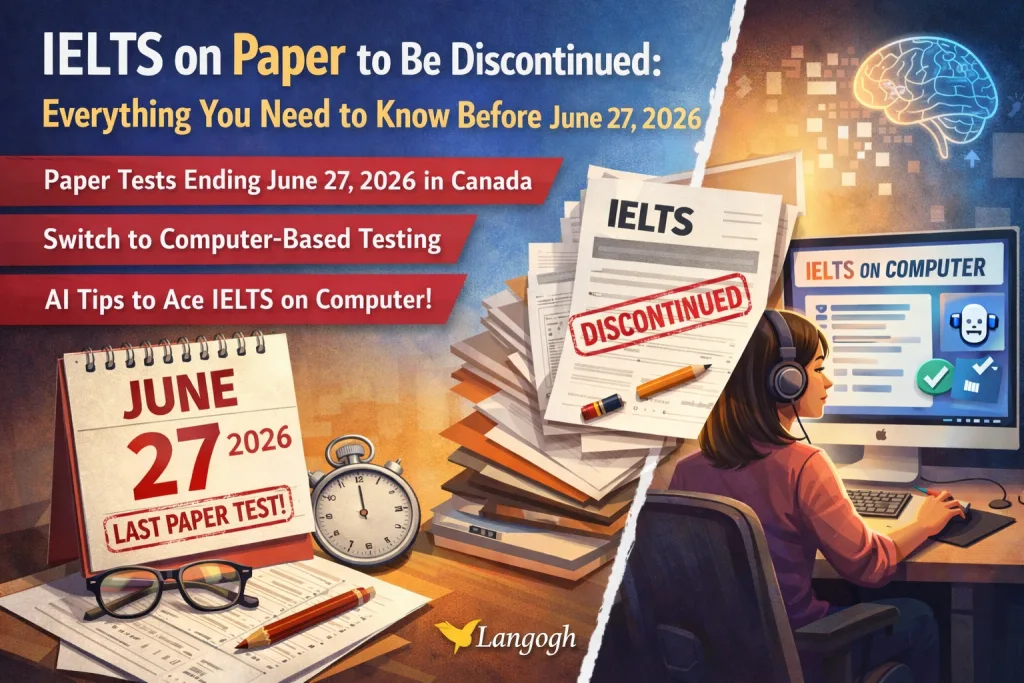
After June 27, 2026, you won’t be able to take IELTS on Paper in Canada. Thousands of test-takers are scrambling to book their final paper-based slots, while others worry whether switching to computer format will hurt their scores. If you’re one of the 340,000+ annual IELTS test-takers in Canada facing this transition, you’re likely asking: Should I rush to book a paper test, or is computer-delivered actually better?
The transition from IELTS on Paper to computer-delivered testing represents the biggest format change in the exam’s 35-year history. According to official IELTS data, this shift affects every test centre in Canada, with limited paper test seats remaining before the June 2026 deadline. The good news? The computer format offers faster results, more test dates, and innovative features like One Skill Retake-but only if you understand how to prepare effectively.
TL;DR: Key Takeaways About IELTS Paper Discontinuation
- Last Paper Test Date: June 27, 2026 is the final date to take IELTS on Paper in Canada
- Limited Availability: Paper test seats are filling fast-book immediately if you want this format
- Test Validity: All paper-based results remain valid for the standard 2-year period
- No Format Changes: Content, difficulty, and scoring (0-9 band scale) stay identical on computer
- New ‘Writing on Paper’ Option: You can still handwrite essays after the transition
- Computer Benefits: Results in 48 hours (vs 13 days), One Skill Retake available, more test dates
- Speaking Test Unchanged: Face-to-face interview with examiner remains the same
- Preparation Strategy: Start practicing on computer format now using AI-powered mock tests to build familiarity
Why Is IELTS on Paper Being Discontinued in Canada?
IELTS on Paper is being phased out because research shows computer-delivered testing provides higher test-taker satisfaction and operational efficiency. According to British Council and IDP Education data, over 67% of test-takers worldwide now choose computer-delivered IELTS when given the option.
The decision stems from three core factors:
1. Test-Taker Satisfaction and Convenience
Research conducted by Cambridge Assessment English reveals that candidates prefer computer-delivered tests for practical reasons:
- Faster results: 48 hours vs 13 days for paper
- More test dates: Up to 3x more available slots per month
- Flexible scheduling: Evening and weekend options
- Editing tools: Cut, copy, paste for Writing tasks
- Word counter: No more manual counting
2. Innovation and Flexibility
Computer-delivered testing enables features impossible with paper format:
- One Skill Retake: Retake just one section (Speaking, Writing, Reading, or Listening) instead of the entire test if you’re close to your target score
- Adaptive technology: Future AI-driven improvements
- Accessibility features: Adjustable font sizes, screen colors
3. Environmental and Operational Efficiency
Digital testing reduces paper waste, printing costs, and logistical complexity. Test centres can accommodate more candidates per day, reducing wait times for bookings.
For a comprehensive understanding of how the computer format works, read our guide on computer-delivered IELTS.
Critical Dates and Timeline: When Does IELTS Paper Format End?
June 27, 2026 marks the absolute last date you can sit for IELTS on Paper in Canada. Here’s the complete timeline:
| Date | What Happens |
|---|---|
| Now – June 27, 2026 | IELTS on Paper still available (limited seats) |
| June 27, 2026 | Final IELTS on Paper test date in Canada |
| June 28, 2026 onwards | Only computer-delivered IELTS available |
| Post-transition | ‘Writing on Paper’ option introduced for computer tests |
Booking Urgency: Why You Should Act Now
According to official IELTS test centre data, paper test slots are filling 3-4 months in advance in major cities like Toronto, Vancouver, and Montreal. If you strongly prefer paper format:
- Book immediately: Seats are limited and booking windows are shortening
- Check multiple centres: Some smaller cities may have more availability
- Consider backup dates: Have 2-3 preferred dates ready
- Prepare for computer anyway: You may not secure a paper slot
IELTS on Paper vs Computer: What Actually Changes (And What Doesn’t)
The exam content, difficulty level, and scoring criteria remain 100% identical between paper and computer formats. Let’s break down exactly what changes and what stays the same:
What Stays EXACTLY the Same:
✅ Test Content: Same question types, topics, and difficulty
✅ Scoring System: Same 0-9 band scale and descriptors
✅ Assessment Criteria: Identical marking rubrics for all sections
✅ Test Duration: Same time limits (2 hours 45 minutes total)
✅ Speaking Component: Face-to-face interview with certified examiner
✅ Question Formats: All question types available in both formats
For detailed scoring information, review the IELTS band score system.
What Changes (Computer Advantages):
| Feature | Paper | Computer |
|---|---|---|
| Results Time | 13 days | 3-5 days (often 48 hours) |
| Test Dates | Limited (usually weekends) | More frequent (including weekdays) |
| Writing Tools | Pen, paper, manual crossing out | Cut, copy, paste, undo |
| Word Count | Manual counting required | Automatic word counter |
| Reading/Listening | Paper booklet | On-screen with highlighting tools |
| One Skill Retake | Not available | Available for Academic tests |
| Test Locations | Fewer centres | More centres available |
For an in-depth format comparison, see our detailed comparison of paper vs computer formats.
The New ‘Writing on Paper’ Option: Best of Both Worlds
After the paper format discontinuation, IELTS will introduce a hybrid ‘Writing on Paper’ option. This addresses the primary concern of test-takers who feel more comfortable handwriting their essays.
How ‘Writing on Paper’ Works:
- Reading & Listening: Completed on computer
- Writing Task 1 & 2: Handwritten on physical answer sheets
- Speaking: Face-to-face with examiner (unchanged)
Who Should Choose ‘Writing on Paper’?
Consider this option if you:
- Have significantly faster handwriting than typing
- Think more clearly when writing by hand
- Struggle with keyboard-based editing
- Feel anxious about technology during tests
However, research shows most test-takers actually score HIGHER on computer due to:
- Easier text reorganization and editing
- No handwriting legibility issues
- Automatic word counting reduces stress
- More time for content improvement vs rewriting
Why Computer-Delivered IELTS Is Actually Better for Most Test-Takers
Despite initial hesitation, 78% of test-takers report preferring computer format after trying it once. Here’s why computer-delivered IELTS might be your best choice:
1. Lightning-Fast Results (48 Hours vs 13 Days)
Time sensitivity matters. Consider these scenarios:
- University deadlines: Application deadlines don’t wait
- Visa processing: Immigration timelines are tight
- Job offers: Employment may depend on quick results
With computer-delivered IELTS, you receive your Test Report Form in as little as 48 hours-critical when every day counts toward deadlines.
2. One Skill Retake: Don’t Waste $250+ Retaking Everything
The One Skill Retake feature is a game-changer for Academic test-takers. Here’s the reality:
- Traditional approach: Score Band 7.5 in three sections but Band 6.5 in Writing? Pay $340 CAD to retake the ENTIRE test
- One Skill Retake: Pay a reduced fee to retake ONLY Writing within 60 days
According to official IELTS statistics, approximately 35% of test-takers miss their target score by just one section. One Skill Retake can save you hundreds of dollars and weeks of preparation time.
3. Superior Editing and Writing Tools
Computer format provides practical advantages for IELTS Writing practice:
Paper Writing Challenges:
- Crossing out creates messy essays
- Rewriting wastes valuable time
- Manual word counting causes anxiety
- Handwriting legibility can affect scores
Computer Writing Advantages:
- Cut/copy/paste for easy reorganization
- Undo button for quick corrections
- Automatic word counter eliminates guesswork
- Clear, legible text every time
4. More Test Dates and Locations
Computer-delivered IELTS offers:
- Up to 7 days per week: vs 1-2 days for paper
- Morning and afternoon slots: Choose your peak performance time
- More test centres: Greater geographic accessibility
- Faster booking: Less competition for slots
Real Test-Taker Success Story: From Paper Panic to Computer Confidence
Meet Sarah, a 28-year-old software engineer from Toronto applying for Canadian permanent residence. She needed IELTS scores by March 2026 for her Express Entry profile.
The Problem: Sarah had taken IELTS on Paper twice, scoring Band 6.5 in Writing both times despite needing Band 7.0. She wasted $680 CAD on test fees and spent 8 months preparing without improvement. With paper tests being discontinued and limited slots available, she felt desperate.
The Solution: Sarah switched to computer-delivered IELTS and used Langogh’s AI Writing Coach for targeted practice. The platform’s instant feedback identified her specific weaknesses:
- Repetitive vocabulary (Lexical Resource issue)
- Unclear paragraph transitions (Coherence and Cohesion gaps)
- Grammar errors she never noticed
The Result: After just 6 weeks of focused practice on computer format using AI feedback, Sarah scored Band 7.5 in Writing-a full band higher than her paper attempts. The computer format’s editing tools helped her reorganize ideas quickly, and the word counter eliminated her counting anxiety.
Tired of failing IELTS Writing and burning $250+ per retake? Langogh’s AI Writing Coach analyzes your essays like a real examiner, highlights grammar mistakes, shows you exactly why you’re losing marks, and rewrites your text to native Band 9 level.
Start Your Free AI Writing Analysis Now →
How to Prepare for Computer-Delivered IELTS: Proven Strategies
The biggest mistake test-takers make is preparing on paper when they’ll test on computer. Your preparation format must match your test format for optimal performance.
Strategy 1: Practice on Computer from Day One
Your brain needs to automate computer-based tasks BEFORE test day. Practice:
- Typing speed: Aim for 40+ words per minute
- Reading on screen: Build stamina for digital text
- Using highlighting tools: Practice efficiently marking passages
- Keyboard shortcuts: Learn copy/paste, undo, select all
Start with free IELTS practice tests that simulate the exact computer interface.
Strategy 2: Master Time Management on Computer
Computer format changes time dynamics:
Reading Section:
- No separate answer transfer time (unlike paper)
- Must enter answers directly on screen
- Use highlighting tools to mark key information
- Practice reading speed on screens vs paper
Writing Section:
- Stop manually counting words
- Use word counter to check targets (150/250 words)
- Spend saved time improving content quality
- Practice paragraph reorganization with cut/paste
For comprehensive preparation, explore our IELTS preparation resources.
Strategy 3: Take Realistic Computer-Based Mock Tests
According to Cambridge Assessment data, test-takers who complete 3+ computer-based mock tests score 0.5-1.0 bands higher on test day. Why? Because realistic mock tests help you:
- Build familiarity with the interface
- Reduce technology-related anxiety
- Identify weak areas early
- Practice under timed, test-like conditions
Strategy 4: Get Instant, Examiner-Level Feedback
The fatal flaw in most IELTS preparation: practicing without knowing what you’re doing wrong. Traditional methods mean:
- Writing essays with no one to correct them
- Paying $50-100 per hour for human tutors
- Waiting days for feedback (then forgetting the essay)
- Generic advice that doesn’t address YOUR specific mistakes
AI-powered platforms solve this by providing:
- Instant scoring: Know your band score in seconds
- Specific error identification: See exactly what you did wrong
- Criteria-based breakdown: Understand Task Achievement, Coherence, Lexical Resource, Grammar
- Band 9 rewrites: Learn how native speakers would write your essay
For targeted improvement, use our specialized modules:
Stuck practicing IELTS without real feedback? Most test-takers waste months writing essays that no one corrects, speaking answers no one evaluates, and reading passages without understanding their mistakes. Langogh’s AI Simulator acts like a real IELTS examiner-scoring your performance instantly, explaining your errors in plain English, and showing you exactly how to improve.
Try Your First Free AI Mock Test →
Common Myths About Computer-Delivered IELTS (Debunked)
Myth 1: “Computer IELTS Is Harder Than Paper”
Reality: Official IELTS statistics confirm identical difficulty levels and scoring across formats. The content comes from the same question bank, and the same certified examiners mark both formats.
Myth 2: “I’ll Score Lower Because I Type Slowly”
Reality: Research shows that after just 2-3 weeks of daily typing practice, most test-takers match their handwriting speed. The editing advantages typically result in HIGHER scores.
Myth 3: “Speaking Test Will Become Computerized”
Reality: IELTS has committed to maintaining the face-to-face Speaking interview with a trained examiner. This remains unchanged regardless of format transitions.
Myth 4: “Universities Prefer Paper Test Results”
Reality: Universities, immigration authorities, and employers cannot distinguish between paper and computer test scores on the Test Report Form. Both are equally valid and accepted worldwide.
Myth 5: “Computer Format Tests Different Content”
Reality: Question types, topics, difficulty, and assessment criteria are identical. The only difference is the delivery method (screen vs paper).
For more information about IELTS acceptance, see our guide on what is IELTS.
How to Book Your IELTS Test Before Paper Format Ends
If you’re determined to take IELTS on Paper before June 27, 2026, follow these steps:
Step 1: Check Availability Immediately
- Visit official IELTS websites (British Council, IDP Education)
- Search for paper-based test dates in your city
- Check multiple nearby test centres
- Note: Availability is extremely limited
Step 2: Register and Pay Quickly
- Current Canadian test fee: Approximately $340 CAD
- Payment methods: Credit card, debit card
- Registration deadline: Usually 5 days before test date
- Prepare identification documents (passport)
Step 3: Prepare for Plan B
- Reality check: You may not get a paper slot
- Start computer-based preparation simultaneously
- Consider computer format as your primary option
- Book a computer test as backup
Step 4: Begin Preparation Regardless of Format
- Don’t wait for confirmation to start studying
- Core skills (vocabulary, grammar, fluency) transfer between formats
- Practice all four sections systematically
- Focus on content quality over format preferences
Calculate your target score using our IELTS score calculator.
What If You Can’t Get a Paper Test Booking?
The reality: Most test-takers won’t secure paper slots before the deadline. Here’s your strategic action plan:
Embrace Computer-Delivered IELTS
Rather than panicking, recognize the advantages:
- More available test dates means less scheduling stress
- Faster results accelerate your application timeline
- Better tools actually improve most candidates’ scores
- One Skill Retake option provides a safety net
Invest in Quality Preparation Tools
Your success depends more on preparation quality than test format. Focus on:
Essential preparation elements:
- Realistic practice tests: Simulate exact test conditions
- Instant feedback: Identify mistakes immediately
- Targeted improvement: Address specific weak areas
- Speaking practice: Overcome fluency barriers
- Writing correction: Learn from examiner-level analysis
Build Computer Confidence
Allocate 30 minutes daily to:
- Type practice essays (timed)
- Read IELTS-length passages on screen
- Use online highlighting and note-taking tools
- Complete listening tasks with computer-based answers
For comprehensive speaking preparation, try AI-powered Speaking practice that simulates real examiner interactions.
The Financial Reality: Computer Format Saves You Money
Let’s examine the true cost of each format over a typical test-taker’s journey:
Paper-Based IELTS Journey:
- Test fee: $340 CAD
- Results wait time: 13 days
- Retake entire test if one section fails: Another $340 CAD
- Total preparation time: 3-6 months
- Private tutor (optional): $50-100/hour × 20 hours = $1,000-2,000 CAD
- Average attempts to reach target: 2.3 attempts
- Total cost: $782-2,782 CAD
Computer-Delivered IELTS Journey:
- Test fee: $340 CAD
- Results wait time: 48 hours
- One Skill Retake option: ~$120-150 CAD (retake one section only)
- AI-powered preparation: Free to $99/month
- Average attempts to reach target: 1.7 attempts (with proper AI feedback)
- Total cost: $459-678 CAD
Savings with computer format: $323-2,104 CAD
Your Next Steps: Action Plan for IELTS Success
Whether you’re taking your last paper test or transitioning to computer, follow this strategic roadmap:
Immediate Actions (This Week):
- ✅ Check paper test availability for your preferred dates
- ✅ Book computer test as backup (or primary choice)
- ✅ Take a diagnostic test to identify your current level
- ✅ Start typing practice daily (30 minutes)
- ✅ Review computer-delivered IELTS format
Short-Term Strategy (Next 4 Weeks):
- Complete 2-3 full-length computer-based mock tests
- Analyze results to identify weak sections
- Focus 60% of study time on weakest skill
- Build typing speed to 40+ words per minute
- Practice reading stamina on screens (60 minutes daily)
Long-Term Excellence (8-12 Weeks):
- Complete 6+ realistic mock tests under timed conditions
- Get professional feedback on 10+ Writing essays
- Practice 20+ Speaking responses with evaluation
- Master time management for each section
- Achieve consistent target scores in practice
For a complete preparation strategy, read our guide on how to prepare for IELTS.
Ready to stop guessing and start improving? Most test-takers waste 3-6 months preparing without structured feedback, wondering why their scores don’t improve. Langogh’s AI Mock Tests replicate the exact computer-delivered IELTS experience, provide instant band scores for all four sections, and generate detailed improvement reports showing precisely what to fix before test day.
Get Your Free AI-Scored Mock Test →
Conclusion: The End of Paper Is the Beginning of Better Preparation
The discontinuation of IELTS on Paper in Canada by June 27, 2026 marks a significant transition, but not one to fear. Computer-delivered IELTS offers faster results, more flexible scheduling, innovative features like One Skill Retake, and superior editing tools-advantages that help most test-takers achieve higher scores.
Whether you manage to book one of the final paper test slots or embrace computer-delivered format, your success ultimately depends on one factor: quality preparation with instant, examiner-level feedback. The format matters far less than your strategy, practice consistency, and ability to identify and fix mistakes before test day.
Don’t let format changes delay your dreams of studying abroad, immigrating to Canada, or advancing your career. Take control of your IELTS preparation today with proven strategies and AI-powered feedback that adapts to your unique weaknesses.
For comprehensive IELTS resources and strategies, visit our complete IELTS guide and start your journey to Band 7+ today.
Frequently Asked Questions
Find answers to common questions about this topic
The final date to sit for IELTS on Paper in Canada is June 27, 2026. After this date, all IELTS tests will be computer-delivered, though a 'Writing on Paper' option will be available for those who prefer handwriting their essays.
Yes, absolutely. All IELTS on Paper test results remain completely valid for the standard two-year period from your test date, regardless of when the paper format is discontinued. Universities, immigration authorities, and employers will continue to accept these scores.
No. The content, difficulty level, scoring criteria, and band scale (0-9) are identical for both formats. Research shows that test-takers actually report higher satisfaction with computer-delivered tests due to faster results (48 hours vs 13 days) and features like word count tools.
Yes. Starting after June 27, 2026, test-takers can choose the new 'Writing on Paper' option, which allows you to handwrite your Writing Task 1 and Task 2 responses on paper while completing Reading and Listening sections on computer.
Computer-delivered IELTS offers results in 48 hours (vs 13 days for paper), more test dates and locations, the One Skill Retake option for Academic tests, a built-in word counter, easier text editing, and the same face-to-face Speaking test with a real examiner.
Related Articles