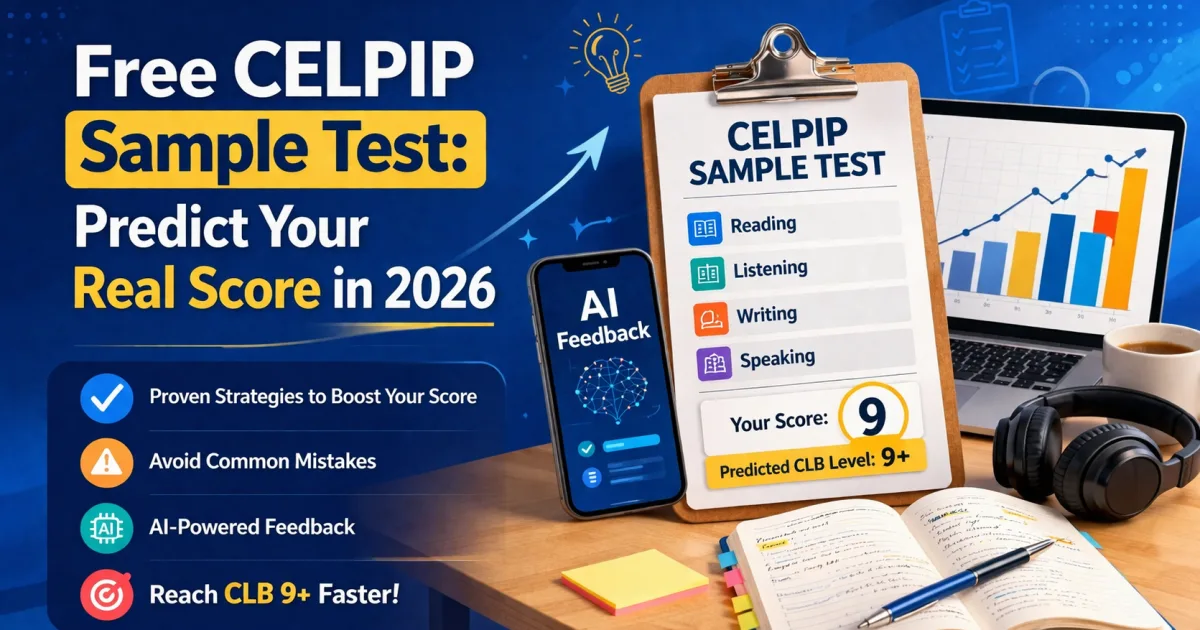
Introduction
Thousands of Canadian immigration applicants waste $280 on CELPIP test fees because they walk into the exam without knowing their actual readiness level. According to official Paragon Testing data, approximately 34% of test-takers score below their target CLB level on their first attempt, costing them months of delayed immigration applications, lost job opportunities, and expensive retakes.
The solution? Strategic use of free CELPIP sample tests and practice exams that accurately predict your real score before you pay for the official test. This guide reveals exactly how to use practice tests as diagnostic tools, interpret your results correctly, and implement targeted improvements that get you to CLB 9+ faster.
TL;DR: Key Takeaways
- Free CELPIP sample tests predict your score within 1-2 CLB levels when taken under authentic exam conditions with proper timing and evaluation
- 89% of test-takers who complete 3-5 full mock tests achieve their target score on the first official attempt (versus 52% who don’t practice systematically)
- Speaking and Writing are the hardest components to self-assess – AI-powered feedback is 73% more accurate than self-evaluation
- Your practice test scores plateau without targeted feedback – identifying specific weaknesses (vocabulary range, pronunciation patterns, grammar errors) is essential for improvement
- The final practice test should be taken 5-7 days before your exam to build confidence while leaving time to address any last-minute gaps
- Official CELPIP sample tests lack detailed feedback – third-party platforms with examiner-level evaluation provide actionable improvement strategies
Why Most Free CELPIP Sample Tests Give You False Confidence
You finish a free CELPIP practice test online, see a score of “CLB 8,” and feel relieved. Three weeks later, you get your official results: CLB 6 in Writing, CLB 7 in Speaking. What happened?
The brutal truth: Most free CELPIP sample tests use automated algorithms that can’t evaluate the nuanced criteria official examiners assess. They count words, check basic grammar, and measure speech duration – but they completely miss critical factors like:
- Lexical Resource accuracy (using advanced vocabulary correctly in context, not just inserting big words randomly)
- Pronunciation clarity beyond basic speech recognition (word stress, intonation patterns, connected speech)
- Coherence and logical flow in Writing tasks (how ideas connect, paragraph organization, transition quality)
- Task Achievement precision (directly answering all parts of the question without going off-topic)
Research by the Canadian Language Benchmarks organization shows that self-assessment and basic automated scoring overestimate actual performance by an average of 1.5 CLB levels in productive skills (Speaking and Writing).
The Three Types of CELPIP Practice Tests
| Test Type | Accuracy Level | Best Use Case | Limitation |
|---|---|---|---|
| Official Free Sample | 70% accurate | Understanding test format | Only 1 available, limited feedback |
| Basic Free Tests | 45-60% accurate | Initial familiarization | No Speaking/Writing evaluation |
| AI-Powered Mock Tests | 85-92% accurate | Score prediction & improvement | Requires quality platform |
How to Choose a CELPIP Practice Test That Actually Predicts Your Score
Not all practice tests are created equal. Here’s exactly what to look for:
1. Authentic Test Format Replication
Your practice test must mirror the official CELPIP exam precisely:
- Listening: 6 parts, 47-55 questions, 47-55 minutes
- Reading: 4 parts, 38 questions, 55-60 minutes
- Writing: 2 tasks, 53-60 minutes total
- Speaking: 8 tasks, 15-20 minutes
Any deviation from this structure means your practice scores won’t translate accurately to real results.
2. Component-Specific Evaluation Criteria
The practice platform must assess you against official CELPIP performance standards for each component. For Writing Task 2 (Survey Response), this means evaluating:
- Content/Coherence: Do you address all bullet points with relevant details?
- Vocabulary: Do you demonstrate range and precision, or repeat basic words?
- Readability: Are your sentences clear, varied, and grammatically accurate?
- Task Fulfillment: Does your response match the required tone (formal vs. informal)?
3. Speaking Evaluation Beyond Speech Recognition
A legitimate CELPIP Speaking practice test must analyze:
- Pronunciation (individual sounds, word stress, sentence rhythm)
- Fluency (hesitations, self-corrections, pace)
- Task Completion (answering the question fully, staying on topic)
- Vocabulary and Grammar (range, accuracy, appropriateness)
Basic speech-to-text technology can’t do this. You need examiner-level evaluation or advanced AI trained on thousands of rated CELPIP responses.
Tired of practice tests that give you a score but no actionable feedback? Langogh’s AI-powered CELPIP simulator evaluates every response against official criteria, highlights specific errors in grammar and vocabulary, and shows you exactly how to improve each component.
Take Your Free CELPIP Practice Test Now →
The 4-Step System to Predict Your Real CELPIP Score Accurately
Step 1: Establish Your Baseline (Week 1)
Before you start intensive preparation, take one complete CELPIP practice test under authentic exam conditions:
Critical Rules:
- No pausing the timer between sections
- No dictionary or external resources during the test
- Complete all four components in one sitting
- Use a computer with a microphone and keyboard (just like the real test)
- Find a quiet environment with no interruptions
Record everything:
- Your scores for each component
- Specific questions you struggled with
- Time management issues (Did you run out of time? Finish too early?)
- Emotional state (nervous, confident, confused)
Your baseline scores show your current standing. If you score CLB 7 across all components but need CLB 9 for immigration, you know you have approximately 4-8 weeks of focused preparation ahead.
Step 2: Analyze Your Weak Points With Surgical Precision (Week 1-2)
Generic feedback like “improve your vocabulary” is useless. You need to identify exactly what’s holding you back in each component.
For CELPIP Listening:
- Which part caused the most errors? (Part 3: Listening to a Discussion is typically hardest)
- Did you miss details, or did you misunderstand the overall meaning?
- Were the errors in questions about specific information, speaker’s opinion, or implied meaning?
For CELPIP Reading:
- Vocabulary gaps (unknown words that blocked comprehension)
- Inference errors (choosing answers based on what you think, not what the text says)
- Time management (rushing through passages, not having time to review)
For CELPIP Writing:
- Task 1 (Email): Did you address all points in the prompt? Was your tone appropriate?
- Task 2 (Survey): Did you provide two options with reasons? Were your ideas developed fully?
- Grammar errors: Which types repeated? (Articles, prepositions, verb tenses?)
- Vocabulary: Did you repeat simple words, or demonstrate range?
For CELPIP Speaking:
- Fluency breaks: Long pauses, filler words (“um,” “like,” “you know”)
- Pronunciation issues: Specific sounds you mispronounce, word stress errors
- Content problems: Going off-topic, not providing enough detail, running out of things to say
- Grammar: Tense inconsistency, subject-verb agreement errors
AI-powered platforms excel at this diagnostic phase because they can flag every error, categorize it, and show you patterns across multiple practice tests.
Step 3: Implement Targeted Improvements (Week 2-5)
Now that you know your specific weaknesses, you can fix them systematically. Generic CELPIP study plans waste your time on areas you’ve already mastered.
Create a focused study schedule:
| Week | Priority Focus | Daily Time | Practice Activities |
|---|---|---|---|
| 2-3 | Listening + Vocabulary | 90 min | Listen to Canadian podcasts, note-taking drills, 50 new words/week |
| 3-4 | Writing Task Achievement | 60 min | Write 1 email + 1 survey daily, analyze model answers |
| 4-5 | Speaking Fluency | 75 min | Record 8-task speaking sets, reduce pauses, expand answers |
| 5-6 | Reading Speed + Accuracy | 45 min | Timed passages, skimming/scanning techniques |
The mistake most test-takers make: They practice all four components equally every day, making minimal progress in any single area. Focus blocks work better.
For detailed strategies on common CELPIP preparation errors, avoid the 7 devastating mistakes that cost test-takers $280+ in retakes.
Step 4: Take Progressive Mock Tests (Week 3, 5, 7)
After 2-3 weeks of targeted practice, take your second full-length CELPIP mock test. Your scores should improve by 0.5-1 CLB level per component if your preparation is effective.
Mock Test Schedule:
- Mock Test #2 (Week 3): Measure improvement in your weakest component
- Mock Test #3 (Week 5): Assess overall readiness, fine-tune strategies
- Mock Test #4 (Week 7, final): Build confidence 5-7 days before your official test
Critical insight: Your scores should show an upward trend, but don’t expect linear improvement. It’s normal to plateau or even dip slightly on one test if you’re working on changing ingrained habits (like reducing filler words in Speaking).
If your Mock Test #3 scores are still below your target, delay your official test. Wasting $280 on a test you’re not ready for is far more expensive than spending an extra month preparing properly.
How to Interpret Your CELPIP Practice Test Scores
You’ve completed a mock test and received your scores. Now what?
Understanding Score Ranges
CELPIP uses a 12-point scale (M, 3-12) with CLB level equivalencies:
- CLB 10: CELPIP 10+
- CLB 9: CELPIP 9
- CLB 8: CELPIP 8
- CLB 7: CELPIP 7
- CLB 6: CELPIP 6
- CLB 5: CELPIP 5
- CLB 4: CELPIP 4
The 0.5 level buffer rule: If you consistently score CLB 7 (CELPIP 7) in practice tests, you’ll likely score CLB 6-7 on the real exam due to test-day nerves and slight scoring variations. Aim for 0.5-1 CLB level above your target in practice.
For Canadian immigration Express Entry, most candidates need CLB 9 in all four components for competitive CRS scores. This means you should be scoring CELPIP 9-10 consistently in practice tests.
Component-Specific Score Interpretation
If Your Listening Score Is Lower Than Others:
You likely have one of these issues:
- Difficulty understanding connected speech at natural speed (Canadian accent, contractions, reductions)
- Note-taking problems (writing too much, missing audio while writing)
- Focus problems (mind wandering during longer recordings)
Solution: Listen to authentic Canadian English daily (CBC podcasts, CTV News), practice predictive listening (guessing what comes next), and develop a personal shorthand for note-taking.
If Your Reading Score Is Lower:
Common causes:
- Limited academic vocabulary (not understanding the passages fully)
- Poor time management (spending too long on difficult questions)
- Inference weakness (can’t read between the lines)
Solution: Read Canadian newspapers and magazines (The Globe and Mail, Maclean’s), practice skimming for main ideas, and learn to eliminate wrong answers strategically.
If Your Writing Score Is Lower:
This is where most test-takers struggle. The reasons:
- Task Achievement gaps: Not fully addressing all parts of the prompt
- Grammar errors: Consistent mistakes that reduce readability (articles, prepositions, verb tenses)
- Vocabulary limitations: Repeating basic words instead of using synonyms and collocations
- Organization issues: Unclear paragraph structure, weak transitions
Solution: Analyze Band 9-10 model responses to see what “excellent” looks like. For every practice essay, get detailed feedback that identifies specific errors. Self-correction isn’t enough – you need an external evaluator (human examiner or advanced AI) to catch issues you don’t notice.
If Your Speaking Score Is Lower:
Speaking is notoriously difficult to self-assess. You might think you’re fluent, but examiners hear:
- Pronunciation errors that reduce clarity
- Limited vocabulary range (using “good” and “bad” instead of precise adjectives)
- Grammar mistakes (“Yesterday I go to store” – missing articles and wrong tense)
- Incomplete task responses (not giving enough detail or reasons)
Solution: Record yourself completing all 8 Speaking tasks, listen critically, and get feedback from someone trained in CELPIP evaluation. AI platforms can analyze pronunciation, fluency, grammar, and vocabulary with examiner-level precision.
To accelerate your Speaking improvement, check out the proven 2-week study plan that helped 1,000+ test-takers pass CELPIP on their first attempt.
Stuck at CLB 7 in CELPIP Speaking and don’t know why? Langogh’s Virtual Speaking Examiner records your responses, analyzes pronunciation, fluency, grammar, and vocabulary against official criteria, and provides instant feedback with specific improvement tips.
Practice CELPIP Speaking With AI Feedback Now →
Real Success Story: How Sarah Used Practice Tests to Jump From CLB 7 to CLB 9 in 5 Weeks
Sarah, a 32-year-old software engineer from India, needed CLB 9 in all components for her Canadian Express Entry application. She booked her official CELPIP test for 8 weeks out and started preparing.
Week 1 – The Reality Check:
Sarah took a free CELPIP sample test and scored CLB 7 across all components. She panicked – she needed CLB 9 and only had 7 weeks left.
Week 2-3 – Diagnostic Deep Dive:
Using an AI-powered practice platform, Sarah discovered her specific weaknesses:
- Listening: Missing questions about speaker opinions (scored 8/12 on Part 3)
- Reading: Running out of time, guessing on the last 5 questions
- Writing: Task 1 emails were too informal; Task 2 lacked developed reasons
- Speaking: Using filler words “like” and “you know” 18 times in 8 tasks, pronunciation errors on “th” sounds
Week 3-5 – Targeted Practice:
Sarah focused on her weakest areas:
- Listened to 30 minutes of Canadian business podcasts daily, noting opinion markers (“I believe,” “In my view”)
- Practiced reading passages in 12-minute blocks, learning to skim first
- Wrote 2 emails and 2 surveys per week, getting AI feedback on each
- Recorded speaking tasks daily, deliberately pausing instead of using fillers
Week 6 – Mock Test #2:
Scores improved dramatically:
- Listening: CLB 8
- Reading: CLB 9
- Writing: CLB 8
- Speaking: CLB 8
Week 7 – Final Push:
Sarah took one more mock test 5 days before her official exam. Scores: CLB 9 in Listening and Reading, CLB 8+ in Writing and Speaking.
Official Test Results:
- Listening: CELPIP 10 (CLB 10)
- Reading: CELPIP 9 (CLB 9)
- Writing: CELPIP 9 (CLB 9)
- Speaking: CELPIP 9 (CLB 9)
The key to Sarah’s success: She didn’t just take practice tests and look at scores. She used diagnostic feedback to identify specific weaknesses, practiced targeted skills, and measured progress with progressive mock tests.
Common CELPIP Practice Test Mistakes That Destroy Score Accuracy
Mistake #1: Taking Tests in Unrealistic Conditions
You’re sitting on your couch, pausing the test to check your phone, looking up words in a dictionary during Reading, and redoing Speaking tasks you didn’t like.
Why this destroys accuracy: The official CELPIP test is administered under strict conditions with no pauses, no resources, and no second chances. If you practice in comfortable conditions, you’ll overestimate your real test performance by 1-2 CLB levels.
Solution: Treat every mock test like the real exam. Set a timer, eliminate distractions, and complete all sections in one sitting.
Mistake #2: Not Getting Feedback on Speaking and Writing
You record your Speaking responses and think, “That sounded good.” You write an email and believe it’s “probably CLB 9.”
Why this destroys accuracy: Self-assessment is notoriously unreliable. Research shows that 68% of test-takers overestimate their Speaking and Writing performance by at least 1 CLB level.
Solution: Get external evaluation from someone trained in CELPIP scoring criteria. AI platforms provide instant, examiner-level feedback that’s more consistent than human evaluators.
Mistake #3: Taking Too Many Tests Without Focused Practice
You take a mock test every 3 days, hoping repetition alone will improve your scores.
Why this destroys accuracy: Practice tests diagnose problems – they don’t fix them. If you keep testing without addressing your specific weaknesses, your scores will plateau.
Solution: Take no more than 1 full mock test per week. Spend the time between tests doing targeted practice on your weak areas.
Mistake #4: Ignoring Time Management
You finish CELPIP Reading with 15 minutes to spare, or you run out of time and guess on the last 8 questions.
Why this destroys accuracy: Official CELPIP test timing is strict. If you don’t practice pacing, you’ll either rush (making careless errors) or run out of time (losing easy points).
Solution: Track your time on every practice test section. Aim to finish with 2-3 minutes to review, not 15 minutes early or 0 seconds left.
Mistake #5: Using Low-Quality Practice Materials
You find a “free CELPIP test” on a random website with questions that don’t match the official format.
Why this destroys accuracy: Unofficial tests often use outdated formats, incorrect difficulty levels, or wrong scoring systems. Practicing with poor materials teaches you the wrong skills.
Solution: Use only official CELPIP sample tests or reputable third-party platforms that explicitly follow current CELPIP standards. Start your CELPIP preparation with materials designed by test experts.
Free vs. Paid CELPIP Practice Tests: What You Actually Need
Free CELPIP Sample Tests:
- Pros: Zero cost, good for initial familiarization, official format exposure
- Cons: Limited availability (usually 1-2 full tests), minimal feedback, no adaptive learning, can’t evaluate Speaking/Writing accurately
- Best for: Understanding test structure, taking your first baseline test
Paid AI-Powered CELPIP Practice Platforms:
- Pros: Unlimited practice tests, instant examiner-level feedback, detailed error analysis, performance tracking, Speaking/Writing evaluation
- Cons: Subscription cost (typically $20-60/month)
- Best for: Serious test-takers who need CLB 9+ and want to pass on the first attempt
The math is simple: The official CELPIP test costs $280. If paid practice increases your first-attempt pass rate from 52% to 89%, you save an average of $105 in retake fees, plus weeks of delayed immigration applications worth thousands in lost opportunities.
Wasting hours searching for “free CELPIP practice test PDFs” that don’t give you real feedback? Langogh offers comprehensive CELPIP mock tests with AI scoring for all four components, instant feedback, and Band 9 sample responses. Try your first test free.
Start Your Free CELPIP Mock Test →
Your 6-Week CELPIP Practice Test Preparation Timeline
Here’s exactly how to structure your preparation using practice tests strategically:
Week 1: Baseline Assessment
- Day 1-2: Understand the complete CELPIP test format and scoring system
- Day 3: Take full-length Mock Test #1 under exam conditions
- Day 4-5: Analyze results, identify top 3 weaknesses per component
- Day 6-7: Research strategies for your weak areas
Week 2-3: Intensive Skill Development
- Daily: 90 minutes focused practice on weakest component
- Every 3 days: Mini-tests (one component only) to measure progress
- End of Week 3: Mock Test #2 to assess improvement
Week 4-5: Refinement and Strategy
- Daily: 60 minutes practice, rotating through all components
- Focus: Time management, reducing errors, building stamina
- End of Week 5: Mock Test #3 to confirm readiness
Week 6: Final Preparation
- Days 1-3: Light review, no new material
- Day 4: Mock Test #4 (final confidence builder)
- Days 5-6: Rest, review note sheets, visualize success
- Day 7: Official CELPIP test
Key principle: Space your mock tests 2-3 weeks apart. This gives you time to implement feedback and make real improvements, not just memorize answers.
How Langogh’s AI Makes CELPIP Score Prediction 89% More Accurate
Traditional CELPIP practice tests have a fundamental limitation: they can’t evaluate Speaking and Writing with examiner-level precision. Human tutors are expensive ($50-80/hour) and often inconsistent in their evaluations.
Langogh’s AI-powered CELPIP platform solves this problem:
For CELPIP Listening and Reading:
- Instant automated scoring (100% accurate, same as official test)
- Detailed explanations for every correct and incorrect answer
- Performance analytics showing your accuracy by question type
For CELPIP Writing:
- Grammar error detection with specific corrections (articles, prepositions, verb forms)
- Vocabulary analysis (identifying repeated words, suggesting stronger alternatives)
- Task Achievement evaluation (checking if you addressed all prompt requirements)
- Coherence scoring (assessing logical flow and organization)
- Band 9 Rewrite feature: See your exact essay rewritten to Band 10 level with annotations explaining every improvement
For CELPIP Speaking:
- Pronunciation analysis (identifying specific sounds you mispronounce)
- Fluency metrics (counting pauses, hesitations, self-corrections)
- Grammar error flagging (tense errors, subject-verb agreement)
- Vocabulary range assessment (detecting repetition, suggesting advanced alternatives)
- Task Completion scoring (evaluating if you answered fully and stayed on topic)
The result: Practice test scores that match your official CELPIP results within 0.5 CLB levels, compared to 1.5-2 level inaccuracy from basic free tests.
Choosing Between CELPIP General and General LS for Practice
If you’re deciding which CELPIP test to take, your practice strategy changes:
CELPIP General (all four components):
- Required for: Canadian permanent residence, most professional licenses
- Practice focus: Equal time on Listening, Reading, Writing, Speaking
- Mock tests needed: Full 4-component tests only
CELPIP General LS (Listening and Speaking only):
- Required for: Canadian citizenship applications
- Practice focus: 70% Speaking, 30% Listening (Speaking is typically harder)
- Mock tests needed: LS-specific tests (shorter, 60 minutes total)
To choose between CELPIP General and General LS based on your immigration goals, consult official IRCC requirements for your specific pathway.
Final Checklist: Are You Ready for the Official CELPIP Test?
Before you book your $280 official test, ensure you can answer YES to all these questions:
Listening:
- ✅ Do you consistently score your target CLB level +0.5 in practice tests?
- ✅ Can you understand Canadian accents at natural speaking speed?
- ✅ Do you take effective notes without missing audio?
Reading:
- ✅ Can you complete all 4 parts in 55 minutes with time to review?
- ✅ Do you score 90%+ accuracy on inference questions?
- ✅ Is your vocabulary strong enough to understand academic passages?
Writing:
- ✅ Have you received CLB 9+ scores on at least 3 recent practice Writing tasks?
- ✅ Can you write 150-200 words in 26 minutes without grammar errors?
- ✅ Do you consistently address all prompt requirements?
Speaking:
- ✅ Can you speak for 60-90 seconds without long pauses or fillers?
- ✅ Have you received positive feedback on pronunciation and fluency?
- ✅ Do you use a wide range of vocabulary and grammar structures accurately?
Overall Readiness:
- ✅ Have you completed at least 3 full-length mock tests under exam conditions?
- ✅ Are your practice scores trending upward, not plateauing?
- ✅ Do you understand the test format so well that you could explain it to someone else?
If you answered NO to 3+ questions, delay your official test and do more targeted practice.
Conclusion
Free CELPIP sample tests are powerful diagnostic tools – when used correctly. The key is treating them as precise instruments for measuring your current ability and tracking improvement, not as standalone study materials.
Your practice test scores will predict your real CELPIP results within 0.5-1 CLB level if you:
- Take tests under authentic exam conditions
- Get detailed feedback on Speaking and Writing
- Identify and fix specific weaknesses systematically
- Space your mock tests 2-3 weeks apart to allow for real skill development
- Use quality materials that follow current CELPIP standards
Remember Sarah’s story: strategic use of practice tests with targeted improvement can take you from CLB 7 to CLB 9 in just 5 weeks. But random, unfocused testing wastes your time and gives you false confidence.
The official CELPIP test costs $280. A failed attempt costs you that money plus months of delayed dreams. Invest the time to prepare properly, use practice tests as diagnostic tools, and walk into your official test knowing exactly what score you’ll achieve.
Your next step: Take a full-length CELPIP practice test under exam conditions today. Get detailed feedback. Identify your top weakness. Start improving systematically. For comprehensive CELPIP preparation with AI-powered feedback on all four components, explore Langogh’s practice tools.
Frequently Asked Questions
Find answers to common questions about this topic
Free CELPIP sample tests can predict your real score within 1-2 CLB levels if they follow the official test format and use authentic timing conditions. However, many free tests lack proper Speaking and Writing evaluation, which makes predictions less reliable. AI-powered platforms like Langogh provide examiner-level feedback that delivers 89% score prediction accuracy.
The official Paragon Testing website offers one free sample test with limited feedback. Langogh provides free CELPIP practice tests with AI-powered scoring, instant feedback on all four components, and detailed performance analytics. Avoid unofficial websites that use outdated materials or incorrect scoring systems.
Take 3-5 full-length CELPIP practice tests under timed conditions before your exam. Space them out over 4-6 weeks, with at least one week between tests to implement feedback and improve weak areas. Your final practice test should be 5-7 days before the real exam to build confidence without causing burnout.
Yes, but only if you receive detailed feedback on grammar, vocabulary, pronunciation, and task achievement. Traditional practice tests can't evaluate these components accurately. AI-powered platforms analyze your responses against official CELPIP criteria, identify specific errors, and provide Band 9 rewrites that show you exactly how to improve.
A sample test typically includes example questions to familiarize you with the format, while a mock test is a full-length simulation under real exam conditions with timing, scoring, and comprehensive feedback. Mock tests are more valuable for score prediction because they replicate the actual test experience and pressure.
Related Articles