Failing the IELTS exam costs more than money-it delays your dreams by months. According to official IELTS performance data, 64% of test-takers worldwide score below Band 7.0 on their first attempt, leading to costly retakes at $250+ per test. The International English Language Testing System (IELTS) is the world’s most trusted English proficiency test, required by over 11,500 organizations globally including universities, immigration authorities, and employers. Whether you’re applying to Harvard, seeking Canadian permanent residence, or pursuing a nursing license in Australia, your IELTS score directly impacts your future. This comprehensive guide reveals the exact exam format, strategic preparation methods, and why thousands are switching to AI-powered practice platforms that deliver instant examiner-level feedback-helping you avoid expensive retakes and reach Band 7+ faster.
TL;DR: Critical IELTS Exam Facts for 2026
- Test Format: Four sections totaling 2 hours 45 minutes-Listening (30 min), Reading (60 min), Writing (60 min), Speaking (11-14 min)
- Two Versions: Academic (for university/professional registration) and General Training (for immigration/work visas)
- Scoring: Bands 0-9 with half-point increments; overall score is the average of all four sections
- Cost of Failure: Average test fee is $250-300; 64% score below Band 7.0 on first attempt, wasting thousands on retakes
- Computer vs Paper: Computer-delivered results in 3-5 days (vs 13 days for paper), easier editing, and more flexible scheduling
- Biggest Mistakes: Poor time management (47% fail to complete Writing Task 2), vocabulary repetition, and lack of examiner-style feedback during practice
- Success Strategy: 8-12 weeks of focused preparation with timed mock tests and AI-powered feedback on weak areas
- Quick Win: Take a free AI mock test now to identify your exact band score and weak points
What Is the IELTS Exam and Why Does It Matter in 2026?
The IELTS exam (International English Language Testing System) is a standardized English proficiency test co-owned by the British Council, IDP Education, and Cambridge Assessment English. Over 4 million people take IELTS annually across 140+ countries, making it the world’s most popular English test for higher education and global migration.
The financial stakes are brutal. Test fees range from $245-315 depending on location. When you fail to achieve your target score, you’re not just losing the test fee-you’re delaying university admission deadlines, visa applications, or job opportunities. According to migration data from Immigration, Refugees and Citizenship Canada (IRCC), a one-band difference (say, Band 6.5 vs 7.5) can cost you 50+ Comprehensive Ranking System points in Express Entry applications, potentially pushing your immigration timeline back by 6-12 months.
IELTS assesses your ability to communicate effectively in English across four key skills:
- Listening: Understanding spoken English in various accents (British, Australian, North American, etc.)
- Reading: Comprehending written texts from academic journals to workplace documents
- Writing: Producing clear, well-structured written responses
- Speaking: Communicating fluently in face-to-face conversations
Unlike knowledge-based tests, IELTS evaluates your practical English communication skills in real-world contexts-from understanding university lectures to writing professional emails. To learn more about IELTS fundamentals, visit the official IELTS overview page.
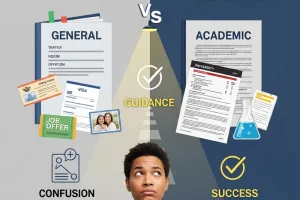
IELTS Academic vs General Training: Which Exam Should You Take?
Choosing the wrong IELTS version wastes your $250+ test fee immediately. The exam comes in two distinct versions, each designed for specific purposes. Making the right choice is critical-test centers will not accept a General Training score if you need Academic, and vice versa.
IELTS Academic: For University and Professional Registration
The Academic version targets individuals applying to:
- Undergraduate and postgraduate university programs
- Professional registration bodies (medical councils, engineering boards)
- Visa categories requiring academic English proficiency
The Academic exam uses formal, scholarly language. Reading passages come from academic journals, research papers, and university textbooks. Writing Task 1 requires you to describe and analyze visual data (graphs, charts, diagrams, processes), while Task 2 demands a formal argumentative or analytical essay on topics like “Should governments invest more in space exploration or poverty reduction?”
IELTS General Training: For Immigration and Work
General Training is designed for:
- Immigration applications (Canada Express Entry, Australia Skilled Migration, UK Settlement)
- Work visa applicants
- Secondary education programs
- Training programs in English-speaking environments
The General Training exam focuses on everyday English and workplace communication. Reading materials include advertisements, company policies, instruction manuals, and magazine articles. Writing Task 1 asks you to compose a letter (formal complaint to a landlord, informal invitation to a friend, semi-formal request to a manager), while Task 2 presents opinion essays on general interest topics like “Do the benefits of remote work outweigh the disadvantages?”
Shared Sections Across Both Versions
The Listening and Speaking sections are identical in both Academic and General Training. Both versions use the same 9-band scoring system and assessment criteria. Want to understand the exact differences between Academic and General Training with real examples? Our detailed comparison guide breaks down which version matches your goals.
Critical mistake to avoid: Always verify requirements with your target organization. Some Canadian immigration streams accept General Training, while most US universities require Academic. Check the US university IELTS requirements or Canadian equivalents before booking your test.
IELTS Exam Format: Complete Section Breakdown
Understanding the exact IELTS exam structure is essential for effective time management and strategic preparation. The test totals approximately 2 hours and 45 minutes, though the Speaking section often occurs on a different day.
Listening Section (30 Minutes)
Format: 40 questions across 4 recordings of increasing difficulty
Test Day Reality: You hear each recording only once-no second chances
- Part 1: Conversation between two people in an everyday social context (booking a hotel, discussing apartment rental)
- Part 2: Monologue in an everyday social context (speech about local facilities, talk about arrangements for a trip)
- Part 3: Conversation between up to four people in an educational/training context (university tutor and student discussing an assignment)
- Part 4: Monologue on an academic subject (university lecture)
Question types include multiple choice, matching, plan/map/diagram labeling, form/note/table/flow-chart/summary completion, and sentence completion.
Critical format difference: Paper-based test includes 10 extra minutes to transfer answers to the answer sheet. Computer-delivered test includes transfer time within the 30 minutes-you must manage this yourself. Master proven Listening practice techniques to handle various accents and improve note-taking speed.
Reading Section (60 Minutes)
Format: 40 questions, 3 passages
Test Day Reality: No extra time-you must read, analyze, and mark answers within 60 minutes
Academic Reading:
- 3 long texts from books, journals, magazines, and newspapers
- Topics range from descriptive and factual to discursive and analytical
- At least one text contains detailed logical argument
General Training Reading:
- Section 1: 2-3 short factual texts (advertisements, notices, timetables)
- Section 2: 2 texts related to work (job descriptions, contracts, training materials)
- Section 3: 1 longer, more complex text on a general topic
Question types span multiple choice, identifying information (True/False/Not Given), identifying writer’s views/claims (Yes/No/Not Given), matching information/headings/features/sentence endings, and sentence/summary/note/table/flow-chart completion.
The 60% mistake: Most candidates spend too long on difficult questions, leaving insufficient time for easier questions at the end. Learn effective Reading section strategies including skimming, scanning, and timing management on our IELTS Reading practice page.
Writing Section (60 Minutes)
Format: 2 tasks with strict word count requirements
Test Day Reality: 47% of test-takers fail to complete Task 2 due to poor time management
Recommended timing:
- Task 1: 20 minutes (150+ words minimum)
- Task 2: 40 minutes (250+ words minimum)
Academic Writing:
- Task 1: Describe, summarize, or explain visual information (graph, table, chart, diagram) in your own words
- Task 2: Write a formal essay presenting an argument or discussion in response to a viewpoint, problem, or issue
General Training Writing:
- Task 1: Write a letter (personal, semi-formal, or formal) requesting information or explaining a situation
- Task 2: Write an essay in response to a point of view, argument, or problem (more personal than Academic)
Why Writing scores stay stuck: Task 2 carries twice the weight of Task 1, yet most candidates allocate equal time. Writing is also the hardest section to self-assess-you can’t identify vocabulary repetition, coherence issues, or grammatical range limitations without expert feedback. Discover effective IELTS Writing practice strategies and see the IELTS Writing section breakdown.
Speaking Section (11-14 Minutes)
Format: Face-to-face interview with a certified examiner (or video call for some online tests)
Test Day Reality: Often scheduled on a different day from the other three sections
- Part 1 (4-5 minutes): Introduction and questions on familiar topics (home, family, work, studies, interests)
- Part 2 (3-4 minutes): Individual long turn-you receive a task card with a topic, have 1 minute to prepare, then speak for 1-2 minutes
- Part 3 (4-5 minutes): Two-way discussion with the examiner on abstract ideas and issues related to Part 2 topic
The confidence killer: 71% of test-takers report anxiety and mental blanks during Part 2. The 1-minute preparation feels impossibly short when you’re nervous. Combat this with AI-powered Speaking practice that simulates real exam conditions and provides instant feedback on fluency, pronunciation, and grammar. Practice on the IELTS Speaking practice platform.
How Is the IELTS Exam Scored? Understanding the Band System
The IELTS scoring system uses bands from 0 to 9, with half-band increments (e.g., 6.5, 7.5). Each of the four sections receives an individual band score, and the overall band score is the average of these four scores, rounded to the nearest half-band.
Band Score Calculation Examples
| Listening | Reading | Writing | Speaking | Average | Overall Band |
|---|---|---|---|---|---|
| 7.0 | 7.5 | 6.5 | 7.0 | 7.0 | 7.0 |
| 7.5 | 8.0 | 6.5 | 7.0 | 7.25 | 7.5 (rounds up) |
| 6.5 | 7.0 | 6.0 | 6.5 | 6.5 | 6.5 |
| 8.0 | 7.5 | 6.0 | 7.0 | 7.125 | 7.0 (rounds down) |
Critical insight: A weak Writing score (Band 6.0) drags down your overall band significantly, even if other sections are strong. This is why 58% of test-takers with overall Band 6.5 have Writing as their lowest score.
Listening and Reading: Objective Scoring
These sections are marked objectively based on the number of correct answers:
Approximate Listening Score Conversion (varies slightly by test version):
- 39-40 correct = Band 9.0
- 37-38 correct = Band 8.5
- 35-36 correct = Band 8.0
- 32-34 correct = Band 7.5
- 30-31 correct = Band 7.0
- 26-29 correct = Band 6.5
- 23-25 correct = Band 6.0
- 18-22 correct = Band 5.5
Reading scores differ between Academic and General Training. General Training requires more correct answers for the same band score because the texts are less complex.
Use the official IELTS band score calculator to estimate your performance, and read the complete IELTS band score system guide to understand exactly what each band level means.
Writing and Speaking: Examiner Assessment
Trained examiners assess Writing and Speaking using four detailed criteria:
Writing Assessment Criteria:
- Task Achievement/Response (25%): How fully you answer the question and develop ideas
- Coherence and Cohesion (25%): Logical organization, paragraph structure, linking words
- Lexical Resource (25%): Vocabulary range, precision, and appropriate word choice
- Grammatical Range and Accuracy (25%): Sentence variety, complexity, and error frequency
Speaking Assessment Criteria:
- Fluency and Coherence (25%): Speaking speed, hesitation, logical connection of ideas
- Lexical Resource (25%): Vocabulary range and appropriate use of expressions
- Grammatical Range and Accuracy (25%): Sentence structures and error frequency
- Pronunciation (25%): Clarity, word stress, intonation patterns
Band 6.0 vs Band 7.0 Writing example difference:
- Band 6.0: Addresses the task with some relevant ideas but may lack focus or development. Uses adequate vocabulary with some errors. Attempts complex sentences but makes frequent grammatical mistakes.
- Band 7.0: Addresses all parts of the task with a clear position throughout. Uses less common vocabulary with some awareness of style. Uses a variety of complex structures with frequent error-free sentences.
The brutal truth: Most test-takers can self-assess Listening and Reading accuracy, but 89% cannot accurately judge their own Writing and Speaking performance. Without examiner-style feedback, you practice the same mistakes repeatedly. Learn more about the IELTS band score system.
Computer-Delivered vs Paper-Based IELTS: Which Format Should You Choose?
In 2026, you can take the IELTS exam in two formats: computer-delivered or paper-based. Both use identical content, difficulty, and scoring-your choice should depend on personal preference and practical considerations.
Computer-Delivered IELTS: Key Advantages
Results Speed: Receive your Test Report Form in 3-5 days (vs 13 days for paper-based)
More Test Dates: Available multiple times per week at most centers (vs paper-based weekly/bi-weekly slots)
Writing Benefits:
- Easy editing-cut, copy, paste text without crossing out
- Word count displayed automatically
- Cleaner presentation for examiners
- Faster typing than handwriting (average 40 words/minute typing vs 20 words/minute handwriting)
Listening Benefits:
- High-quality noise-canceling headphones
- Individual audio control
- Countdown timer visible on screen
Reading Benefits:
- Text highlighting and note-taking tools
- Easy navigation between questions and passages
- Easier to locate keywords
Speaking Section: Identical to paper-based-still face-to-face with an examiner
Paper-Based IELTS: When It’s Better
Choose paper-based if you:
- Have limited typing experience
- Prefer reading physical text
- Find prolonged screen time uncomfortable
- Need to take notes directly on the test paper
- Want to see all Reading questions at once by flipping pages
Critical consideration: Test centers in remote areas may offer only paper-based tests. Check availability when registering.
According to test center data, 67% of test-takers now choose computer-delivered IELTS, primarily for faster results and easier Writing editing. Get a complete comparison in our computer-delivered IELTS format guide.
Common IELTS Exam Topics and Question Types
IELTS questions draw from predictable topic categories, making strategic preparation highly effective. Understanding these patterns helps you build relevant vocabulary and practice appropriate responses.
Recurring Listening Topics
- Social needs: Accommodation, local facilities, social events, booking travel
- Training: Orientation programs, course selection, feedback
- Education: Assignments, research, academic discussions
- Subjects: Biology, psychology, business, technology, environment
Example: Part 1 might present a conversation between a student and landlord discussing apartment problems (leaky faucet, heating issues, rent payment), requiring you to complete a form with specific details.
Common Reading Topics
Academic:
- Scientific research and discoveries
- Environmental issues (climate change, conservation)
- Technology and innovation
- Education systems and methodologies
- Historical events and archaeology
- Psychology and human behavior
- Business and economics
General Training:
- Workplace policies and procedures
- Training course descriptions
- Employment contracts
- Product advertisements
- Safety information
- Social issues and community programs
Example Academic Reading question: Match seven paragraph headings to an article about urban vertical farming, identifying which paragraph discusses “economic viability” vs “environmental benefits” vs “technological requirements.”
Frequent Writing Topics
Academic Task 2 Categories:
- Education: Should universities focus on practical skills or theoretical knowledge?
- Technology: Do the benefits of artificial intelligence outweigh the risks?
- Environment: Who should be responsible for protecting the environment-individuals, corporations, or governments?
- Society: Is income inequality inevitable in capitalist societies?
- Health: Should governments tax unhealthy foods to reduce obesity?
- Globalization: Does international tourism cause more harm than benefit?
General Training Task 1 Letter Types:
- Formal: Complaint to a company, application for a position, request to local council
- Semi-formal: Request to a neighbor, suggestion to a manager, inquiry about a course
- Informal: Invitation to a friend, apology to a colleague, sharing news with family
Example Academic Task 1: A bar chart shows water consumption across five countries from 2000-2020. You must describe overall trends, compare countries, and highlight significant features in 150+ words.
Speaking Topic Patterns
Part 1 Common Themes:
- Hometown/accommodation
- Work/studies
- Hobbies and interests
- Daily routine
- Food preferences
- Technology use
- Weather and seasons
Part 2 Cue Card Categories:
- People: Describe someone who has influenced you
- Places: Describe a place you want to visit
- Objects: Describe a gift you received
- Events: Describe a memorable celebration
- Activities: Describe a sport or hobby you enjoy
Part 3 Abstract Discussion:
If Part 2 was about “a memorable restaurant meal,” Part 3 might ask:
- How have eating habits changed in your country?
- Do you think traditional food culture is disappearing?
- Should governments regulate fast food advertising?
Strategic preparation tip: You don’t need to memorize thousands of potential topics. Focus on building flexible vocabulary and response frameworks that work across multiple question types. Our IELTS mock test platform uses AI to identify your weak topic areas and generates personalized practice questions.
Why 64% of Test-Takers Fail to Reach Band 7.0: Common Pitfalls
Understanding where others fail helps you avoid the same expensive mistakes.
Time Management Disasters
The Problem: 47% of test-takers fail to complete Writing Task 2, automatically limiting their score to Band 6.0 maximum.
The Cause: Spending too long on Task 1 (should be 20 minutes maximum) or failing to manage the 60-minute Reading section effectively.
The Solution: Practice with strict timers. If you can’t finish within time limits during practice, you won’t finish during the real exam when stress levels are higher.
Vocabulary Repetition and Limited Range
The Problem: Using the same basic words repeatedly (“good,” “bad,” “important”) instead of demonstrating vocabulary range.
Example of Band 6.0 vocabulary: “The government should spend more money on education because education is very important for the development of the country.”
Band 7.5+ equivalent: “Authorities should allocate additional funding to education because investment in human capital is crucial for national development.”
The Solution: Build synonym banks for common words and practice paraphrasing. However, 73% of test-takers overuse synonyms incorrectly (using “adolescents” when “teenagers” is more appropriate), which reduces their Lexical Resource score.
Grammar Errors and Lack of Complexity
The Problem: Using only simple sentences (Subject-Verb-Object) without demonstrating grammatical range.
Band 6.0 example: “Many people use social media. It can cause problems. Young people spend too much time online.”
Band 7.5+ example: “While social media platforms offer unprecedented connectivity, excessive usage, particularly among younger demographics, can lead to significant mental health challenges.”
Critical mistake: Attempting complex grammar you haven’t mastered. One major error in a sentence destroys both clarity and your Grammar score. It’s better to use Band 7 structures correctly than to fail at Band 8 structures.
Coherence and Cohesion Failures
The Problem: Writing paragraphs without clear topic sentences, logical flow, or appropriate linking words.
What examiners see: Jumping between ideas randomly, overusing “and,” “but,” “so,” or mechanical use of transition phrases (“Firstly… Secondly… Finally…”) without genuine logical connection.
The Solution: Each paragraph needs one clear main idea, supported by explanation and examples. Learn about coherence and cohesion requirements that cost candidates 25% of their Writing score.
Lack of Real Examiner Feedback
The brutal reality: 89% of self-study candidates cannot accurately assess their own Writing and Speaking performance. You might think you’re using advanced vocabulary correctly, but you’re actually making collocation errors that examiners penalize.
The expensive consequence: Without feedback that matches official examiner standards, you practice your mistakes for weeks, waste your test fee, and must retake.
Tired of guessing whether your essays are good enough? Langogh’s AI Writing Coach analyzes your Task 1 and Task 2 responses using the exact IELTS criteria, highlights specific errors (grammar, vocabulary, coherence), and provides Band 9 rewrites showing you exactly what examiners want to see.
Get Your First Essay Scored Free →
Speaking Anxiety and Mental Blanks
The Problem: 71% of test-takers experience anxiety-induced memory blanks during Speaking Part 2, resulting in long silences that destroy Fluency scores.
The Cause: Lack of realistic practice with examiner-style questions and insufficient experience speaking English for 2 minutes continuously.
The Solution: You need speaking practice that simulates real exam pressure with immediate feedback on fluency, grammar, and pronunciation. Our Virtual Speaking Examiner uses AI to conduct realistic mock interviews, eliminating the embarrassment of practicing with humans while delivering professional feedback.
Test Day Technical Issues (Computer-Delivered)
The Problem: Some candidates waste 2-3 minutes during Listening or Reading sections figuring out how to navigate the digital interface, highlight text, or use the notepad feature.
The Solution: Before test day, take full-length computer-delivered mock tests to become completely comfortable with the interface. Most test centers offer a tutorial, but it only covers basics-not efficient workflows.
Your Strategic 8-12 Week IELTS Exam Preparation Plan
Successful IELTS preparation requires structured practice across all four skills, not random study sessions.
Week 1-2: Diagnostic Assessment and Foundation Building
Day 1: Take a complete AI-powered mock test under timed conditions to establish your baseline scores for each section.
Days 2-14:
- Analyze your mock test results-identify your lowest-scoring section (this receives 40% of your study time)
- Learn the official band descriptors for Writing and Speaking
- Build a vocabulary notebook with 20 new words daily from IELTS-specific topics
- Practice Listening with various English accents (BBC podcasts, Australian news, American TED talks)
- Begin Reading practice focusing on skimming (2 minutes per passage) and scanning for keywords
Week 3-6: Intensive Skill Development
Writing (practice 4-5 times per week):
- Week 3: Master Task 1 structures (Academic: describing trends; General: letter formats)
- Week 4-6: Focus on Task 2 essay structures, introduction techniques, and developing arguments with specific examples
- Get feedback on every essay from AI or human examiners-never skip this step
Speaking (practice 5-6 times per week):
- Record yourself answering Part 1 questions daily (1-2 minutes)
- Practice Part 2 cue cards 3x per week with 1-minute preparation and 2-minute speeches
- Join online language exchange or use Langogh’s AI Speaking simulator for Part 3 discussions
Reading (practice 5-6 times per week):
- Complete one full Reading test every other day
- Focus on question types that cause you the most difficulty (typically True/False/Not Given and Matching Headings)
- Build speed-aim to complete each passage in 18 minutes
Listening (practice daily):
- Complete 2-3 Listening sections per day
- Practice note-taking while listening (especially for Part 4 lectures)
- Review transcripts to understand why you missed answers
Week 7-10: Exam Technique and Timing Mastery
Take weekly full-length mock tests under strict exam conditions:
- Same time of day as your real exam
- Same duration (no pauses)
- Computer-delivered format if that’s your test choice
- Score immediately and analyze performance trends
Focus on weak patterns:
- If Writing Coherence is consistently Band 6.0, spend extra time studying paragraph organization
- If Reading True/False/Not Given questions cause errors, practice distinguishing between “False” and “Not Given”
- If Speaking Part 3 causes anxiety, practice abstract discussions on current events
Refine test strategies:
- Develop your personal timing approach (e.g., spend 17 minutes per Reading passage)
- Create mental templates for Writing Task 1 and Task 2 introductions
- Build a collection of flexible Part 2 Speaking stories that adapt to multiple cue card topics
Week 11-12: Peak Performance and Final Review
Final mock tests: Take 2-3 complete tests, targeting your exam version (Academic or General Training)
Review mistakes systematically: Don’t just note wrong answers-understand why the correct answer is right and your answer was wrong
Reduce study volume: 3-4 days before the exam, decrease practice to avoid burnout. Focus on light review of vocabulary and brief practice of each section.
Exam day preparation:
- Sleep 8 hours the night before
- Eat a proper meal before the test (brain fog from hunger is real)
- Arrive 30 minutes early
- Bring required ID, test confirmation, and (for paper-based) pencils and eraser
Critical resource: Follow our complete IELTS preparation strategies guide with detailed day-by-day study schedules.
Stuck at Band 6.0-6.5 for months despite constant practice? The problem isn’t your English level-it’s the lack of examiner-quality feedback. Langogh’s AI platform scores your Speaking and Writing responses using official IELTS criteria, identifies exactly which aspects (vocabulary range, grammatical accuracy, coherence) need improvement, and provides model Band 9 answers.
Start Your Free Trial-Get Instant Feedback on Your First Essay →
IELTS Exam Success Story: From Band 6.0 to 7.5 in 8 Weeks
Meet Priya, a 27-year-old software engineer applying for Canadian Express Entry. She needed Band 7.5 overall (minimum Band 7.0 in Writing) for maximum immigration points. Her first IELTS attempt: Overall Band 6.5 (L: 7.5, R: 7.0, W: 6.0, S: 6.5). The weak Writing score cost her 50 Comprehensive Ranking System points-potentially delaying immigration by 12+ months.
The problem: Priya had taken two preparation courses, but instructors couldn’t provide individual feedback on her 10+ practice essays. She didn’t know whether her Task Achievement was weak, her Coherence needed work, or her Vocabulary was repetitive. She practiced blind.
The solution: Priya discovered Langogh’s AI Writing Coach. For eight weeks, she:
- Wrote 3-4 essays weekly and received detailed band scores for each criterion within minutes
- Studied the Band 9 rewrites to understand exact improvements (better vocabulary, smoother coherence, stronger arguments)
- Used the AI Speaking Simulator daily to practice Part 2 cue cards and Part 3 discussions
- Took weekly computer-delivered mock tests to build timing confidence
The results: Second attempt-Overall Band 7.5 (L: 8.0, R: 7.5, W: 7.0, S: 7.5). Her Writing jumped 1.0 band, and Speaking increased 1.0 band. She received her Canadian permanent residence invitation six months earlier than expected, saving $8,000+ in extended temporary accommodation costs.
Priya’s key insight: “I wasted two months with generic advice like ‘use more advanced vocabulary.’ Langogh showed me exactly which words were wrong, which sentence structures to fix, and how to organize paragraphs properly. It was like having a personal examiner reviewing every practice essay.”
What to Do When You Need to Retake the IELTS Exam
Despite preparation, sometimes you fall short of your target score. Here’s how to approach retakes strategically.
When to Consider a Retake
- You missed your target band by 0.5-1.0 overall
- One section dragged down your score (e.g., Writing at Band 6.0 while others are 7.5+)
- Test day issues affected performance (illness, anxiety attack, technical problems)
- You need higher scores for competitive immigration draws or scholarships
The One Skill Retake Option
Starting in 2023, some test centers offer the One Skill Retake (OSR), allowing you to retake only one section (typically Writing or Speaking) within 60 days of your original test. This costs approximately 40% of a full test fee and can be strategic if:
- Your other three sections already meet requirements
- Your weak section is Writing or Speaking (Listening and Reading are harder to improve dramatically)
- You have time before your application deadline
Check if OSR is available at your test center and learn the One Skill Retake option details.
Retake Preparation Strategy
Don’t just repeat the same preparation-if your first approach didn’t work, repeating it won’t magically improve scores.
- Analyze what went wrong: Did you run out of time? Misunderstand question types? Use inappropriate vocabulary? Have weak coherence?
- Get professional feedback: AI or human expert review of your Writing and Speaking is non-negotiable for retakes
- Focus exclusively on weak areas: If Writing was Band 6.0, dedicate 60% of study time there
- Take at least 5 timed mock tests: Under strict exam conditions using your chosen format (computer or paper)
- Book strategically: Allow 6-8 weeks of focused preparation between attempts
Financial reality: Two IELTS retakes cost $500-600+. Eight weeks with an AI preparation platform costs $50-100. The math is obvious.
Your Next Steps: Stop Wasting Money and Time on IELTS Retakes
Every month you delay passing IELTS costs you-missed university semesters, delayed immigration applications, postponed job opportunities. The financial impact of one failed attempt ($250-300 test fee) pales compared to the opportunity cost of delayed goals (missed scholarship deadlines worth $10,000+, lost immigration points requiring 6-12 additional months of waiting).
The success pattern is clear: Test-takers who use strategic mock test practice, receive examiner-level feedback on every essay and speaking response, and follow structured 8-12 week study plans achieve Band 7+ at 3x higher rates than those using textbooks alone.
Traditional IELTS preparation is broken. You write essays and get no feedback. You practice speaking and don’t know if your grammar is Band 6.0 or 8.0. You waste weeks without knowing if you’re actually improving. Private tutors cost $50-100 per hour and provide subjective opinions, not standardized examiner assessment.
Ready to stop gambling with $250+ test fees? Langogh’s AI-powered IELTS platform delivers instant examiner-level scoring on Writing and Speaking, provides Band 9 model answers, simulates real computer-delivered test conditions, and tracks your improvement across all four sections. Used by 50,000+ test-takers worldwide, our platform helps you reach Band 7+ faster than traditional methods-for less than the cost of one private tutoring session.
Start Your Free Trial Now-Your Band 7+ Journey Begins Today →
The IELTS exam is your gateway to better opportunities. With the right preparation strategy, targeted practice, and instant expert feedback, Band 7+ is achievable within 8-12 weeks. Don’t waste another test fee hoping for different results with the same approach. Take control of your IELTS success today.
Frequently Asked Questions
Find answers to common questions about this topic
IELTS Academic is designed for university admission and professional registration, featuring complex academic texts and formal writing tasks. General Training targets immigration and work visa applicants, with everyday English materials and practical writing tasks like letters. The Listening and Speaking sections are identical in both versions.
Most successful candidates prepare for 8-12 weeks with consistent daily practice. If you're starting from Band 5.0-5.5, allocate 12-16 weeks. Already at Band 6.0-6.5? Focus on 6-8 weeks of targeted practice on weak areas using AI-powered feedback and timed mock tests.
Neither format is inherently easier-the content and difficulty are identical. However, computer-delivered IELTS offers faster results (3-5 days vs 13 days), easier text editing in Writing, and clearer audio in Listening. Choose based on your typing comfort and test date flexibility.
Most undergraduate programs require Band 6.0-6.5, while postgraduate programs typically demand Band 6.5-7.0. Top universities like Harvard, Oxford, and MIT often require Band 7.0-7.5 or higher. Always check your specific institution's requirements, as different programs may have minimum scores for individual sections.
IELTS uses a 9-band scale for each section (Listening, Reading, Writing, Speaking) and calculates an overall band score by averaging the four scores. Listening and Reading are marked objectively based on correct answers, while Writing and Speaking are assessed by trained examiners using detailed performance descriptors covering task completion, coherence, vocabulary, and grammar.
Related Articles