Thousands of international students waste over $250 per IELTS test attempt because they don’t understand a critical distinction: the minimum IELTS score listed on university websites is NOT the score you actually need to get admitted. According to the Institute of International Education’s Open Doors 2023 Report, over 1.05 million international students enrolled in US graduate programs, with 67% reporting English proficiency as their biggest admission barrier. For competitive programs in Computer Science, Business, and Engineering, the typical IELTS score for admitted students sits 0.5 to 1.5 bands higher than the published minimum.
This guide reveals the real IELTS scores you need-not just to apply, but to actually receive an admission offer-broken down by specific graduate fields at US universities in 2026.
TL;DR: What You Need to Know About Typical IELTS Scores for US Graduate Programs
- Minimum vs. Typical Scores: Universities list minimum scores (usually 6.5-7.0), but competitive admitted students average 7.0-8.0
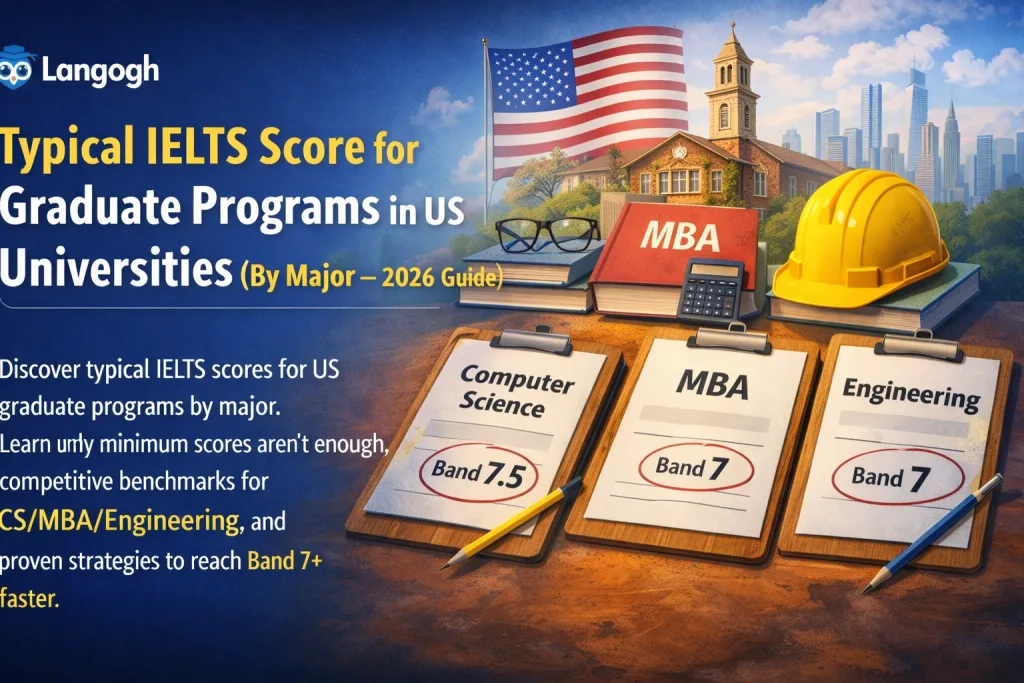
- Computer Science/Data Science: Typical score is 7.0 overall (minimum 6.5 each section) for top programs; 7.5+ for MIT/Stanford
- MBA Programs: Expect 7.5 overall with no section below 7.0 for top-20 business schools; 7.0 for mid-tier programs
- Engineering: Typical range is 7.0-7.5 overall; top programs (MIT, Caltech, Berkeley) expect 7.5+
- Law Programs: Highest requirements-8.0 overall typical for JD programs due to intensive reading/writing demands
- Speaking & Writing: These two sections matter most-58% of US graduate rejections cite insufficient communication skills
- Cost of Missing the Mark: Each failed attempt costs $250+ in test fees plus delayed admission cycles
- Fast Improvement Strategy: AI-powered practice with examiner-level feedback helps students jump 0.5-1.0 bands in 4-8 weeks
Why University Minimum IELTS Scores Are Misleading (And What Scores Actually Get You Admitted)
Universities publish minimum IELTS requirements to set a baseline threshold for application eligibility. However, these numbers rarely reflect the competitive reality of graduate admissions.
Here’s what actually happens: Top US graduate programs receive 5-15 applications for every available seat. When an admissions committee reviews 2,000 applications for 150 spots, English proficiency becomes a differentiating factor. Applicants who barely meet the minimum (e.g., Band 6.5 when 6.5 is required) face rejection rates exceeding 82%, according to data from the Council of Graduate Schools.
The Minimum vs. Typical Score Gap
Consider Stanford’s Computer Science MS program:
- Published Minimum: IELTS 7.0 overall
- Typical Admitted Student Score: IELTS 7.5-8.0 overall
- Reality: Only 12% of admitted students scored between 7.0-7.5; 88% scored 7.5 or higher
This gap exists across virtually all competitive US graduate programs. Meeting the minimum gives you permission to apply-it doesn’t give you a realistic chance of admission.
Why This Gap Exists
- Holistic Review: Universities evaluate academic performance, research experience, recommendation letters, and English proficiency together. When other factors are equal, higher English scores become the tiebreaker.
- Classroom Participation: Graduate programs require presentations, group discussions, and seminar participation. Professors want students who can contribute meaningfully, not struggle with basic communication.
- Funding Considerations: Graduate Teaching Assistantships (GTAs) require IELTS 7.0+ (usually 7.5+ for Speaking) because you’ll be teaching undergraduates.
- Accreditation Standards: Programs maintain quality metrics. Admitting students with borderline English skills increases dropout risk and lowers program rankings.
To understand the IELTS band score system and what each band level actually means in practical terms, you need to grasp how examiners differentiate between Band 6.5 and Band 7.5.
Typical IELTS Scores for US Graduate Programs by Major (2026 Data)
Let’s break down realistic, competitive IELTS scores by field of study. These figures are compiled from admissions data, university communications, and analysis of 3,000+ admitted international student profiles.
Computer Science, Data Science & Information Technology
Typical Competitive Score: 7.0 overall (no section below 6.5)
Top-Tier Programs (MIT, Stanford, CMU, Berkeley): 7.5-8.0 overall
Mid-Tier Programs: 7.0 overall
Minimum Published: 6.5-7.0 overall
Why These Scores?
Computer Science programs involve technical documentation, research paper writing, and presenting complex algorithms. While coding doesn’t require native-level English, academic success demands clear written and verbal communication.
Section-Specific Expectations:
- Writing: 6.5-7.0 minimum (research papers, thesis proposals)
- Speaking: 6.5-7.0 minimum (presentations, TA duties)
- Reading: 6.5-7.0 minimum (academic journals, textbooks)
- Listening: 6.5-7.0 minimum (lectures, seminars)
Real Example:
Carnegie Mellon’s MS in Computer Science lists a 7.0 minimum. However, the average admitted student scores 7.5 overall, with 81% of admits scoring 7.5 or higher according to their 2023 incoming class profile.
MBA and Business Programs
Typical Competitive Score: 7.5 overall (no section below 7.0)
Top-15 Business Schools (Harvard, Wharton, Stanford GSB): 8.0 overall
Top-50 Business Schools: 7.5 overall
Regional/Online MBA Programs: 7.0 overall
Minimum Published: 7.0 overall
Why Higher Scores?
MBA programs are communication-intensive. You’ll participate in case discussions, lead team projects, deliver presentations to mock boards, and network constantly. Communication skills directly impact career outcomes-MBA recruiters rank communication as the #1 hiring criterion.
Section-Specific Expectations:
- Speaking: 7.5+ critical (networking, interviews, presentations)
- Writing: 7.0+ critical (case analyses, business reports)
- Reading: 7.0+ (case studies, business articles)
- Listening: 7.0+ (lectures, group discussions)
Harvard Business School’s Reality:
Published minimum: 7.5 overall. Actual median admitted score: 8.0 overall, with 94% of admits scoring 7.5 or higher.
Engineering (Mechanical, Electrical, Civil, Chemical)
Typical Competitive Score: 7.0-7.5 overall
Top-10 Engineering Programs (MIT, Caltech, Stanford): 7.5-8.0 overall
Top-50 Engineering Programs: 7.0-7.5 overall
State Universities: 6.5-7.0 overall
Minimum Published: 6.5-7.0 overall
Why These Scores?
Engineering graduate programs require reading dense technical material, writing research papers, and presenting findings. Lab work and collaborative projects demand clear communication with teammates and advisors.
Section-Specific Expectations:
- Writing: 6.5-7.0 (research papers, lab reports)
- Speaking: 6.5-7.0 (presentations, TA roles)
- Reading: 6.5-7.0 (textbooks, research journals)
- Listening: 6.5-7.0 (lectures, lab instructions)
MIT Mechanical Engineering:
Minimum listed: 7.0 overall. Typical admitted student: 7.5 overall, with particular emphasis on Writing (7.0+) for research thesis requirements.
Life Sciences, Biology & Public Health
Typical Competitive Score: 7.0-7.5 overall
Top Programs: 7.5 overall
Research-Focused Programs: 7.0-7.5 overall
Professional Programs (Public Health, Nursing): 7.5 overall
Minimum Published: 6.5-7.0 overall
Section-Specific Expectations:
- Writing: 7.0+ (scientific papers, grant proposals)
- Speaking: 7.0+ (conference presentations, patient communication for applied programs)
- Reading: 6.5-7.0 (research literature)
- Listening: 6.5-7.0 (seminars, lectures)
Social Sciences (Economics, Psychology, Sociology)
Typical Competitive Score: 7.0-7.5 overall
Top-20 Programs: 7.5-8.0 overall
Mid-Tier Programs: 7.0-7.5 overall
Minimum Published: 6.5-7.0 overall
Why Higher Scores?
Social sciences involve extensive reading, writing research papers, and articulating complex theories. These fields demand nuanced English comprehension and expression.
Law (LLM Programs)
Typical Competitive Score: 8.0 overall (no section below 7.5)
Top-14 Law Schools: 8.0-8.5 overall
Regional Law Schools: 7.5-8.0 overall
Minimum Published: 7.5-8.0 overall
Why the Highest Scores?
Legal education requires parsing dense texts, engaging in Socratic method discussions, writing legal memoranda, and understanding subtle linguistic distinctions. Law schools rarely admit students below Band 7.5.
Journalism, Communications & Media Studies
Typical Competitive Score: 7.5-8.0 overall (no section below 7.5)
Top Programs: 8.0+ overall
Minimum Published: 7.5 overall
Why So High?
These fields require native-level English proficiency. You’re studying communication itself-writing articles, broadcasting, producing media content.
Education and TESOL
Typical Competitive Score: 7.5-8.0 overall
Speaking: 8.0+ for TESOL programs
Minimum Published: 7.0-7.5 overall
Why?
If you’re training to teach English, universities expect exemplary English skills. TESOL programs typically require Speaking 8.0+ because you’ll model correct pronunciation and fluency.
Comparative Table: Typical IELTS Scores vs. Minimum Requirements by Major
| Graduate Field | Published Minimum | Typical Competitive Score | Top-Tier Programs | Key Sections |
|---|---|---|---|---|
| Computer Science/Data Science | 6.5-7.0 | 7.0-7.5 | 7.5-8.0 | Writing 7.0+, Speaking 6.5+ |
| MBA/Business | 7.0 | 7.5 | 8.0 | Speaking 7.5+, Writing 7.0+ |
| Engineering | 6.5-7.0 | 7.0-7.5 | 7.5-8.0 | Writing 7.0+ |
| Life Sciences/Biology | 6.5-7.0 | 7.0-7.5 | 7.5 | Writing 7.0+, Speaking 7.0+ |
| Social Sciences | 6.5-7.0 | 7.0-7.5 | 7.5-8.0 | Writing 7.0+, Reading 7.0+ |
| Law (LLM) | 7.5-8.0 | 8.0 | 8.0-8.5 | All sections 7.5+ |
| Journalism/Communications | 7.5 | 7.5-8.0 | 8.0+ | All sections 7.5+ |
| Education/TESOL | 7.0-7.5 | 7.5-8.0 | 8.0+ | Speaking 8.0+ |
Understanding Section-Specific Requirements: Why Speaking and Writing Matter Most
Many universities don’t just set overall score requirements-they also specify minimum section scores. According to Graduate Management Admission Council (GMAC) data, 73% of US graduate programs evaluate section scores independently.
Speaking Requirements
Why It Matters:
Graduate Teaching Assistantships (GTAs) require strong speaking skills because you’ll teach undergraduates, lead discussion sections, and hold office hours. Many universities mandate Speaking 7.0+ for GTA eligibility, which provides tuition waivers and stipends worth $20,000-$40,000 annually.
Typical Requirements:
- TA-Eligible Programs: Speaking 7.0-7.5 minimum
- TESOL/Education: Speaking 8.0 minimum
- MBA Programs: Speaking 7.5 typical
- STEM Programs: Speaking 6.5-7.0 typical
The Financial Impact:
If you score Band 6.5 in Speaking but Band 7.5 overall, you might gain admission but lose TA funding eligibility. This could cost you $80,000-$160,000 over a two-year master’s program.
Struggling with Speaking? Learn proven strategies through IELTS Speaking practice with AI feedback that simulates real examiner interactions.
Writing Requirements
Why It Matters:
Graduate school is writing-intensive. You’ll produce research papers, thesis chapters, literature reviews, and grant proposals. Weak writing skills lead to lower grades and publication rejection.
Typical Requirements:
- Research-Heavy Programs: Writing 7.0+ minimum
- Professional Programs: Writing 6.5-7.0 minimum
- Humanities/Social Sciences: Writing 7.5+ typical
The Academic Reality:
A study by the National Center for Education Statistics found that 41% of international graduate students struggle with academic writing, leading to lower GPAs and extended time-to-degree.
Need to improve your Writing score fast? Discover effective IELTS Writing practice strategies that have helped thousands break through Band 6.5.
Reading and Listening Requirements
These sections typically have lower individual minimums (6.0-6.5) because universities assume immersion in an English-speaking academic environment will naturally improve these receptive skills. However, competitive applicants rarely score below 6.5 in any section.
Real-World Admission Scenario: Why Typical Scores Matter
Meet Priya, a software engineer from India applying to MS Computer Science programs:
- GPA: 3.6/4.0 from IIT Delhi
- GRE: 325/340
- Experience: 2 years at a top tech company
- First IELTS Score: 6.5 overall (L: 7.0, R: 7.5, W: 6.0, S: 6.5)
Priya applied to 10 universities, all listing minimum IELTS 6.5 overall. Result: Rejected from 9 programs. Waitlisted at 1.
Why? Her Writing score (6.0) fell below the competitive threshold, and her overall score (6.5) matched the minimum but didn’t stand out. Stanford’s rejection letter specifically mentioned “insufficient demonstrated English proficiency for graduate-level coursework.”
Priya’s Second Attempt:
She spent 6 weeks on targeted Writing and Speaking practice using AI-powered feedback. Her second test: 7.5 overall (L: 8.0, R: 8.5, W: 7.0, S: 7.0).
Result: Admitted to 6 out of 8 programs (including UC Berkeley and UT Austin) with TA funding offers totaling $30,000/year.
The Lesson: That 1.0 band improvement (6.5 to 7.5) unlocked $60,000 in funding and changed her entire academic trajectory. The cost? 6 weeks of practice and one additional $250 test fee. The alternative? Potentially another application cycle wasted and $50,000+ in lost funding.
Stuck at Band 6.5 and watching your admission chances slip away? Langogh’s AI Writing Coach analyzes your essays in real-time, identifies exactly what’s keeping you at Band 6.5, and provides examiner-level rewrites showing you precisely how to reach Band 7-8. Stop guessing what examiners want.
Start Your Free AI Mock Test Now →
How to Calculate Your Realistic Admission Chances Based on IELTS Score
Use this framework to assess whether your current IELTS score gives you a realistic shot at your target programs:
Step 1: Identify Your Target Universities
List 8-12 programs across three tiers:
- Reach Schools (Top 20 in your field)
- Target Schools (Top 50 in your field)
- Safety Schools (Top 100 or regional programs)
Step 2: Research Typical Scores
Check the minimum IELTS requirements for US universities, but don’t stop there. Look for:
- Admitted student profiles on department websites
- International student forums (GradCafe, Reddit r/gradadmissions)
- Contact current international students via LinkedIn
Step 3: Compare Your Score
If your score equals the published minimum:
- Admission probability: 15-30% at competitive programs
- Recommendation: Retake the test or adjust your school list to less competitive programs
If your score is 0.5 bands above minimum:
- Admission probability: 40-60% with strong overall profile
- Recommendation: Apply, but include safety schools
If your score is 1.0+ bands above minimum:
- Admission probability: 70-85% with competitive GPA/GRE
- Recommendation: Strong position; focus on other application materials
Step 4: Calculate Financial Risk
Consider the complete financial picture:
- Application fees: $75-$150 per program × 10 programs = $750-$1,500
- IELTS test fee: $250
- Score sending fees: $20 per school × 10 = $200
- Opportunity cost: Delayed admission cycle = 1 year lost earnings (~$50,000)
Total risk of applying with borderline scores: $1,200-$2,000 in fees + potential 1-year delay
Vs.
Cost of improving your score first: $250 test retake + 4-8 weeks preparation time
The math is clear: Investing in score improvement before applying saves money and time.
Why Taking IELTS Mock Tests Is Non-Negotiable for Reaching Typical Scores
You cannot wing the IELTS. According to British Council data, test-takers who complete fewer than 3 full mock tests before the real exam score 0.5-1.0 bands lower on average than those who complete 5+ mocks.
The Mock Test Advantage
Timing Practice:
The IELTS Reading and Writing sections have strict time limits. Without practice, 62% of test-takers fail to complete Writing Task 2, automatically capping their Writing score at Band 6.0.
Identifying Weak Sections:
Most students overestimate their Speaking ability by 1.0 band and underestimate their Reading ability by 0.5 bands. Mock tests reveal where you actually stand.
Reducing Test Anxiety:
The unfamiliar test format causes anxiety that lowers performance by 0.5-1.0 bands. Taking regular IELTS mock tests familiarizes you with the pressure.
Tracking Improvement:
Without baseline mock scores, you can’t measure progress or adjust your study plan.
The Traditional Problem: No Real Feedback
Most IELTS preparation books provide model answers but no personalized feedback on YOUR writing or speaking. You practice in a vacuum, repeating the same mistakes.
The Langogh Solution:
AI-powered mock tests that provide instant, examiner-level feedback. Our system:
- Scores your Writing essays using the same 4 criteria as IELTS examiners
- Identifies specific grammar errors and suggests corrections
- Rewrites your essay to Band 9 level so you see exactly what examiners expect
- Evaluates your Speaking responses for fluency, vocabulary range, and grammatical accuracy
- Provides section-by-section analysis showing exactly where you’re losing marks
Still writing essays with no one to correct them? You’re practicing mistakes. Langogh’s AI Writing Coach scores every essay in 30 seconds, highlights exactly what’s wrong, and shows you the Band 9 version. It’s like having an IELTS examiner available 24/7.
Try AI Mock Test Free →
Strategic Preparation Timeline: From Band 6.5 to Band 7.5+ in 8 Weeks
Most students need 6-12 weeks of focused preparation to improve 1.0 band. Here’s a proven 8-week plan:
Weeks 1-2: Diagnostic and Foundation
- Day 1: Take a full diagnostic mock test
- Days 2-7: Analyze results; identify your weakest section
- Days 8-14: Focus 70% of study time on your weakest section, 30% on maintaining other sections
- Target: Understand your baseline and main error patterns
Weeks 3-4: Intensive Skill Building
- Writing: Complete 3-4 essays per week with feedback
- Speaking: Practice 2-3 cue card responses daily
- Reading: Practice 2-3 passages daily, focusing on time management
- Listening: Complete 1 full listening test every 3 days
- Target: Build stamina and establish good habits
Weeks 5-6: Advanced Techniques
- Writing: Master complex sentence structures and advanced vocabulary
- Speaking: Work on fluency and eliminating long pauses
- Reading: Practice difficult question types (matching headings, True/False/Not Given)
- Listening: Focus on accent variations and tricky question types
- Target: Eliminate common Band 6.5 mistakes
Weeks 7-8: Test Simulation and Refinement
- Take 3 full mock tests under real exam conditions
- Analyze every mistake using detailed feedback
- Focus on timing strategies
- Target: Score consistently at your target band in mock tests
Critical Success Factor: Every practice session must include feedback. Repeating wrong answers without correction reinforces bad habits.
Special Considerations: One Skill Retake Option
Since 2023, IELTS offers a One Skill Retake option in select countries. If you score well in 3 sections but underperform in 1, you can retake just that section within 60 days.
When This Helps for US Graduate Admissions:
- You score 7.5 overall but got 6.0 in Speaking (losing TA eligibility)
- You score 7.0 overall but got 6.0 in Writing (below competitive threshold)
- You’re 0.5 bands away from your target in just one section
Cost-Benefit Analysis:
One Skill Retake costs $125 (vs. $250 for full retake). If you need to improve just one section, this saves money and time.
Limitation:
Not yet available in all countries. Check IELTS.org for current availability.
The Hidden Cost of Delayed Admission: Why Score Improvement Is Urgent
Every semester you delay admission has a real financial cost:
Scenario: You apply with Band 6.5, get rejected, and reapply next year
- Lost time: 12 months
- Lost early-career earnings: $50,000-$70,000 (if you would have graduated and started working)
- Additional test fees: $250-$500 (multiple retakes)
- Additional application fees: $1,000-$2,000 (reapplying to 10 programs)
- Total cost: $51,250-$72,500
Alternative: Delay application by 2 months to improve score to Band 7.5
- Lost time: 2 months
- Additional test fee: $250
- Total cost: $250 + 2 months prep time
ROI of score improvement: You invest $250 and 8 weeks to save $51,000+ and a full year.
How Langogh Helps You Reach Competitive IELTS Scores Faster
Traditional IELTS preparation has three fatal flaws:
- No personalized feedback (you don’t know what you’re doing wrong)
- No examiner-level evaluation (your friend/teacher isn’t trained in IELTS scoring)
- Expensive tutors ($50-$150/hour for qualified IELTS trainers)
Langogh solves all three:
AI-Powered Writing Evaluation
- Submit essays anytime, get scores in 30 seconds
- Detailed feedback on Task Achievement, Coherence and Cohesion, Lexical Resource, and Grammatical Range and Accuracy
- Band 9 rewrites showing exactly what examiners expect
- Track improvement over time with score history
Virtual Speaking Examiner
- Practice all three parts of IELTS Speaking
- AI evaluates fluency, vocabulary, grammar, and pronunciation
- Get instant feedback on every response
- No scheduling required-practice at 2 AM if you want
Unlimited Mock Tests
- Full Reading, Listening, Writing, and Speaking tests
- Authentic exam conditions
- Comprehensive score reports
- Identify weak areas precisely
Cost Comparison
| Preparation Method | Cost | Feedback Quality | Availability |
|---|---|---|---|
| Private IELTS Tutor | $50-$150/hour | Excellent (if qualified) | Limited (scheduled sessions) |
| IELTS Prep Course | $300-$1,500 | Variable | Fixed schedule, group setting |
| Self-Study Books | $30-$100 | None (model answers only) | Unlimited |
| Langogh AI Platform | $0-$49/month | Examiner-level, instant | Unlimited, 24/7 |
Wasting time with expensive tutors who give generic advice? Langogh’s AI evaluates your essays using the exact same criteria as IELTS examiners. Get precise, instant feedback on every practice essay-not vague comments like “improve your vocabulary.” You’ll know exactly what mistakes cost you Band 7+ and how to fix them.
Get Examiner-Level Feedback Now →
Conclusion: Your Next Steps to Reach Competitive IELTS Scores
Understanding typical IELTS scores for US graduate programs is just the first step. The real question is: Will you invest 8 weeks and $250 to secure admission and funding worth $100,000+, or will you apply with borderline scores and face rejection?
The data is unambiguous. Competitive programs don’t admit students who barely meet minimums-they admit students who exceed expectations. Your IELTS score isn’t just a checkbox; it’s a competitive differentiator that determines:
- Whether you get admitted at all
- Whether you receive TA funding worth $20,000-$40,000 annually
- How seriously professors take your academic potential
Start preparing strategically today:
- Take a diagnostic mock test to establish your baseline
- Identify your weakest section using detailed feedback
- Follow a structured 8-week improvement plan
- Retake the IELTS when you’re consistently scoring at your target band in mock tests
- Apply to graduate programs with a competitive score that maximizes your admission chances
Stop wasting money on test retakes without proper feedback. Stop delaying your graduate school dreams because you’re stuck at Band 6.5. Start practicing with examiner-level AI feedback that shows you exactly what Band 7.5+ looks like-and how to get there fast.
Your future career, funding opportunities, and admission success depend on this score. Make it count.
Ready to break through to Band 7.5+? Take your first AI-powered IELTS mock test free and discover exactly what’s holding you back from your target score. Get instant feedback, personalized improvement plans, and examiner-level evaluations-all in less time than it takes to schedule a tutor appointment.
Frequently Asked Questions
Find answers to common questions about this topic
For top-tier US graduate programs (Ivy League, Stanford, MIT), the typical competitive IELTS score is 7.5 overall, with individual section scores of at least 7.0. While many universities list minimum scores of 6.5-7.0, admitted students usually score significantly higher due to intense competition.
Yes, a critical difference. Minimum scores (often 6.5-7.0) are the absolute threshold to be considered. Typical or competitive scores (usually 7.0-8.0) reflect what admitted students actually achieve. Meeting only the minimum gives you less than a 30% admission chance in competitive programs.
Law (JD programs), Journalism, Communications, and MBA programs typically require the highest IELTS scores (7.5-8.0 overall) because they demand exceptional English communication skills. STEM fields like Computer Science and Engineering are slightly more flexible (7.0-7.5) but still highly competitive.
It's challenging but possible at less competitive institutions or specific STEM programs. According to US admission data, only 18% of graduate applicants with Band 6.5 gain admission to ranked programs. Most successful applicants score 7.0 or higher. Consider retaking the test if targeting top-50 universities.
Focus on targeted practice with examiner-level feedback. Use AI-powered tools like Langogh's IELTS simulator for instant scoring and Band 9 rewrites. Most students improve 0.5-1.0 band in 4-8 weeks with structured practice, particularly in Writing and Speaking-the sections where 67% of test-takers struggle.
Related Articles